From the barista who makes your coffee, to the nanny who raises your children, to the doorman who keeps drug addicts and couriers serving you legal papers out of your building, our lives depend on little people whose existence we basically never acknowledge.
In literature, perhaps even more than in real life, these little people matter. Your reader will not respond to your writing if your world is populated by flat characters who exist only to serve your main protagonist’s narrative, in much the way a judge might respond to you not remembering the names of your company’s custodians and security guards who died when your building burnt down because you were siphoning electricity from next door.
Sure, it’s much easier to go through life not having to think about all the little slave hands who knitted your socks. And dehumanizing others, while sometimes problematic, has had many great benefits throughout human history. For example, we’ve made an impressive stockpile of weapons should aliens ever arrive and threaten our existence.
But writing is about exploring the rich fullness of the human experience. Let’s do a little experiment. Look at this photo:
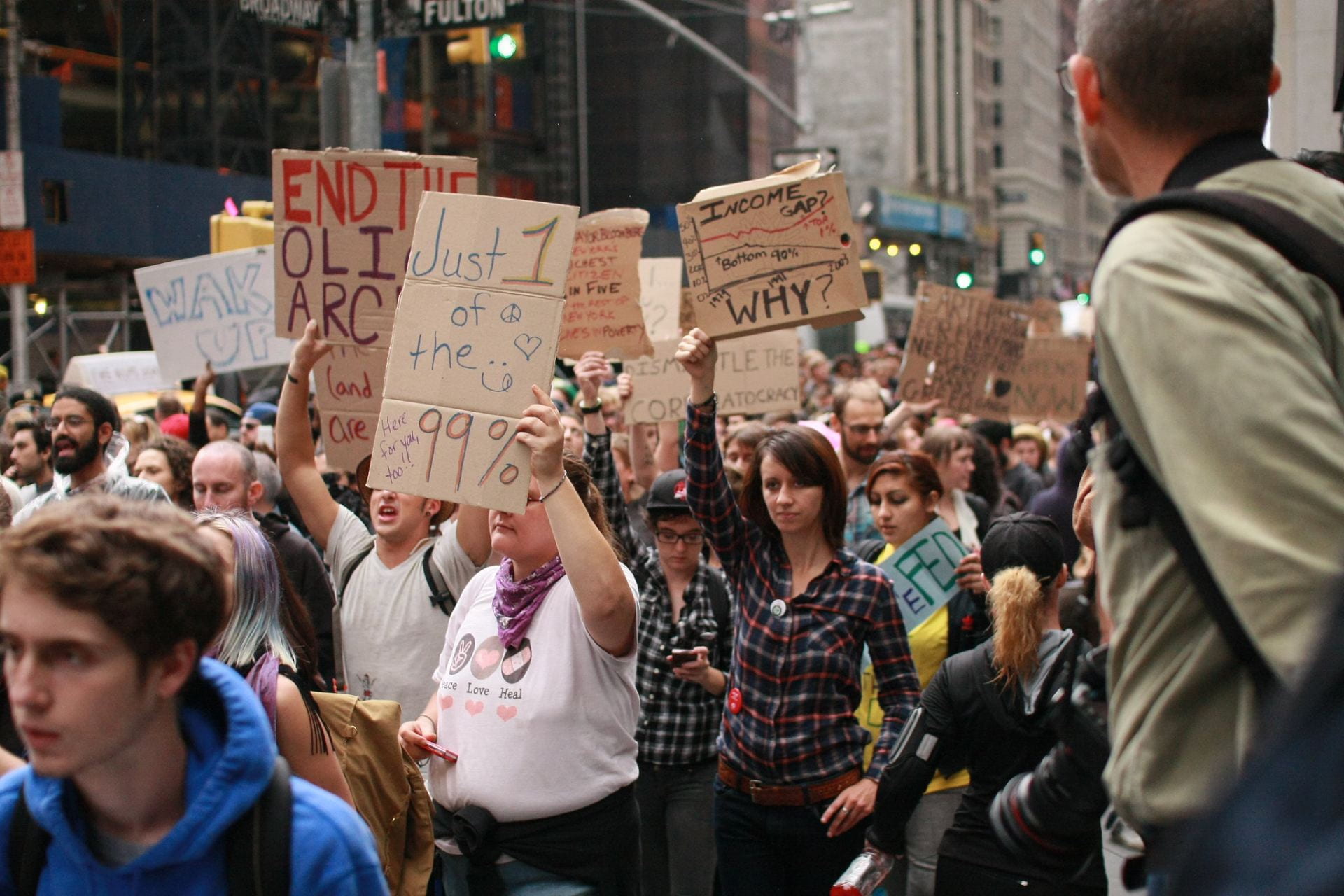
Now at first glance, you probably think it’s some sort of woke mob. You don’t really think of these people as individuals, nor do you consider their individual motivations. “They’re just trying to steal from hardworking billionaires,” you might say to yourself. Some of the more sociopathic of Stories’ Matter viewers might fantasize about following one to their home, strangling them and watching the light go from their eyes. But most of you would probably be fine tear gassing them so they disperse and you can drive to yoga class unimpeded.
But as a writer, use this as an exercise to practice humanizing others. Pick five random people and write a few paragraphs of background.
This woman, for example. Let’s pretend she’s not very politically active but is here to impress this man. You see, last week she first saw him at Whole Foods when he asked if she knew where the arugula was. He was so hot she got tongue-tied and just silently pointed in a random direction, and in fact, she didn’t and still doesn’t know what arugula even is and hopes he doesn’t ever bring it up again. Anyway, she followed him out of the Whole Foods and was excited to learn he only lives a few buildings away so she’s been spending the past few nights hanging around the entrance to his building hoping they’ll cross paths again. If he asks what she’s doing, she’ll say comes to that building to leave food for a stray cat. Anyway, that didn’t happen, he must work nights or something, but this Saturday morning she saw him walk with a group of people to a local protest. And so now she hopes he shouts out some funny slogan or comment so she can laugh really loud and draw his attention.
Anyway, we’ll take radical detours that seem to be pointless on this edition of Stories’ Matter.
~
Now, before we get to the tips, let’s make a clear distinction. Minor characters are not secondary characters. Secondary characters get lots of page space and are crucial to the plot; minor characters are a step below that. To give a relatable analogy, if a main character is a wife, a secondary character is a mistress, and a minor character is a Waffle House waitress from Memphis you once banged while on a book tour whose name and hair color you can’t remember, but you do distinctively remember she got sexually excited by tornadoes.
Tip 1 – Minor Characters Should Feel Like They Have A Life Outside Your Story
A minor character shouldn’t exist just to info dump, nor should their only purpose be to support your protagonist. I mean, in real life the only reason we do things for others is to achieve our own goals. At least that’s how it is for me.
There are lots of ways to do this in your fiction. Give your minor characters a memorable hobby. Hint at a secret motivation. In Blake Colby’s Blood Shot, one of the detectives is trying to solve the crime, but the other is mostly worried about whether or not his wife is having an affair.
This is something I had to learn as a boss, as well. For years, I thought of my workers as mindless drones who only existed to take me more money. But now I make it a point to get to know my employees. For example, every Monday morning, I spend two hours monitoring their social media feeds. This has the added benefit of checking to see if they’re uploading pictures of themselves holding various books from the D&E backlog like I asked.
Tip 2 – Don’t Forget to Give Your Minor Characters a “Look”
Remember, a minor character may only exist on a few pages of a 300-page novel. So you really have to make those words count. Some strange clothing choices or gaping holes where your eyes should be is a great way to grab your reader’s attention.
Try to think of some minor characters in movies whose names you don’t remember but whose look you absolutely do. If you’re anything like me, the first thing that came to mind was the chick with three tits from Total Recall.
There’s science to support this as well. Humans are bad with names, but we’ve been trained to recognize abnormal or differing appearances. This was how we learned to cast sick or genetically inferior people out of our caveman societies. At my publishing company, I remember most people by specific traits instead of names, like “big head,” “nerd face,” “wife material if she smiled more,” and “what I imagine my mom might look like today if she hadn’t abandoned me.”
Tip 3 – Give your minor character a specific role
It’s no secret that lots of books have been written. Because of this, many roles for minor characters have been established. Let’s look at a few.
First, we have comic relief. Think about the gravediggers in Hamlet. In my novel, The House on Pain Avenue, Daniel’s brother’s frat brothers serve as the comic relief. Peeing in the dean’s coffee helps lighten all scenes where Daniel’s father kicks him out of the house for being gay.
Then you have the guide. They are meant to assist the protagonist on their journey. In my novel, Deep Throat II, the titular character guides the journalists in uncovering the president’s pizza parlor child sex ring.
 dragoneaglepublishing.com