If You’re a New Author, You’re Probably Making These Mistakes

If you clicked on this article, I’m guessing you’re having some trouble breaking into the industry. You probably have had dozens of rejection letters from literary agents or indie publishers. So you probably self-published some short stories on a blog, maybe even a novel or two on Amazon, but nobody bought it because why would they? You’re a no-name piece of shit. You know you have talent, but if you died today your obituary would likely list you as a masturbator before a writer. What’s an aspiring writer to do? In today’s article, I’ll discuss some of the biggest mistakes new authors make so hopefully, by the end of this, you’ll have a 1 or 2 percent better chance at becoming famous. 

~

#1 – Not attacking critics at every opportunity

Most new writers experience high rates of rejection. And because most of you were terrible at sports and unpopular in high school, you’ve grown accustomed to let the criticism roll right off your back. Fight that urge. You ever notice how the greatest businesspeople, celebrities and politicians are all huge assholes? That’s because people respect and admire assholes.

The more you stand up for yourself, the more people will take you seriously. Get a bad review? Hack your reviewer’s social media and have them proclaim vocal support for NAMBLA. Get rejected by a literary agent or publisher? Hack their social media and post visual depictions of the Prophet Mohammed.

#2 – Limiting your marketing avenues

As I’ve shown, a social media presence is key for any aspiring author, but most writers stop there. In doing so, you lose a lot of potential readers: the elderly, poor people without access to computers, Luddites, obese people whose fingers are too fat to type, or even people who like to go outside.

You can try these things. If it’s a comedy, read your book in a crowded café and laugh loudly. When people ask you about it, say it’s an unknown author who should be way more famous. If money isn’t an issue, promote it with a billboard. And if money really isn’t an issue, promote with skywriting.

#3 – Writing for yourself

Most writers think writing’s supposed to be fun. But really, the only fun thing about the writing process is giving a busty fan your hotel key card at a book signing, but it takes decades for most writers to get to that point.

Writing is a job, plain and simple. No different than being an office worker or a barista or Secretary General of the United Nations. But unlike any of those jobs, you have to take it seriously, because you’re the boss. So if you quit your day job to become a writer, just remind yourself that you’re doing it for the money and not because you thought it’d be more fulfilling than helping autistic children.

#4 – Spending big bucks on a book cover

Ever heard of the phrase “Don’t judge a book by its cover”? Even schoolchildren know that. It’s the content that matters. But I still see new writers drop four figures for an eye-catching cover. Please stop. Do yourself a favor and spend that hard earned cash on something more useful, like editing, alimony or insulin.

#5 – Disregarding the competition

A big mistake a lot of new writers make is thinking that their work will stand on its own merits. But in reality, your reader is just going to compare your work to other authors they’ve read before. So you need to be proactive. Discredit and shame as many famous authors in your genre as you can. For example, Robert Ludlum rose to prominence largely because he was the first to say Tom Clancy had been using orphan ghostwriters.

#6 – Living your life

Lots of writers think they need to live their life to get inspiration for their writing. Oh, really? You writing a hard-hitting thriller about a porn-obsessed chronic masturbator? Are Midwest summer barbeques a bastion of character, wit and intrigue? Your life is boring and pointless, but your fiction shouldn’t be. Family reunions, recitals, baptisms, funerals and pleasuring your wife just gets in the way of those key edits, those opening hooks that need polishing. Focus on the work. It’s all that matters.

Here are a few more mistakes you can fix on your way to becoming famous.

#7 – Not joining the secret Satanic societies to which most literary agents and New York big six publishers belong

#8 – Not getting an email account

#9 – Using the “hunt and peck” method of typing

#10 – Forgetting that agents are open or susceptible to bribes, extortion and blackmail

How to Write Minor Characters

From the barista who makes your coffee, to the nanny who raises your children, to the doorman who keeps drug addicts and couriers serving you legal papers out of your building, our lives depend on little people whose existence we basically never acknowledge.

In literature, perhaps even more than in real life, these little people matter. Your reader will not respond to your writing if your world is populated by flat characters who exist only to serve your main protagonist’s narrative, in much the way a judge might respond to you not remembering the names of your company’s custodians and security guards who died when your building burnt down because you were siphoning electricity from next door.

Sure, it’s much easier to go through life not having to think about all the little slave hands who knitted your socks. And dehumanizing others, while sometimes problematic, has had many great benefits throughout human history. For example, we’ve made an impressive stockpile of weapons should aliens ever arrive and threaten our existence.

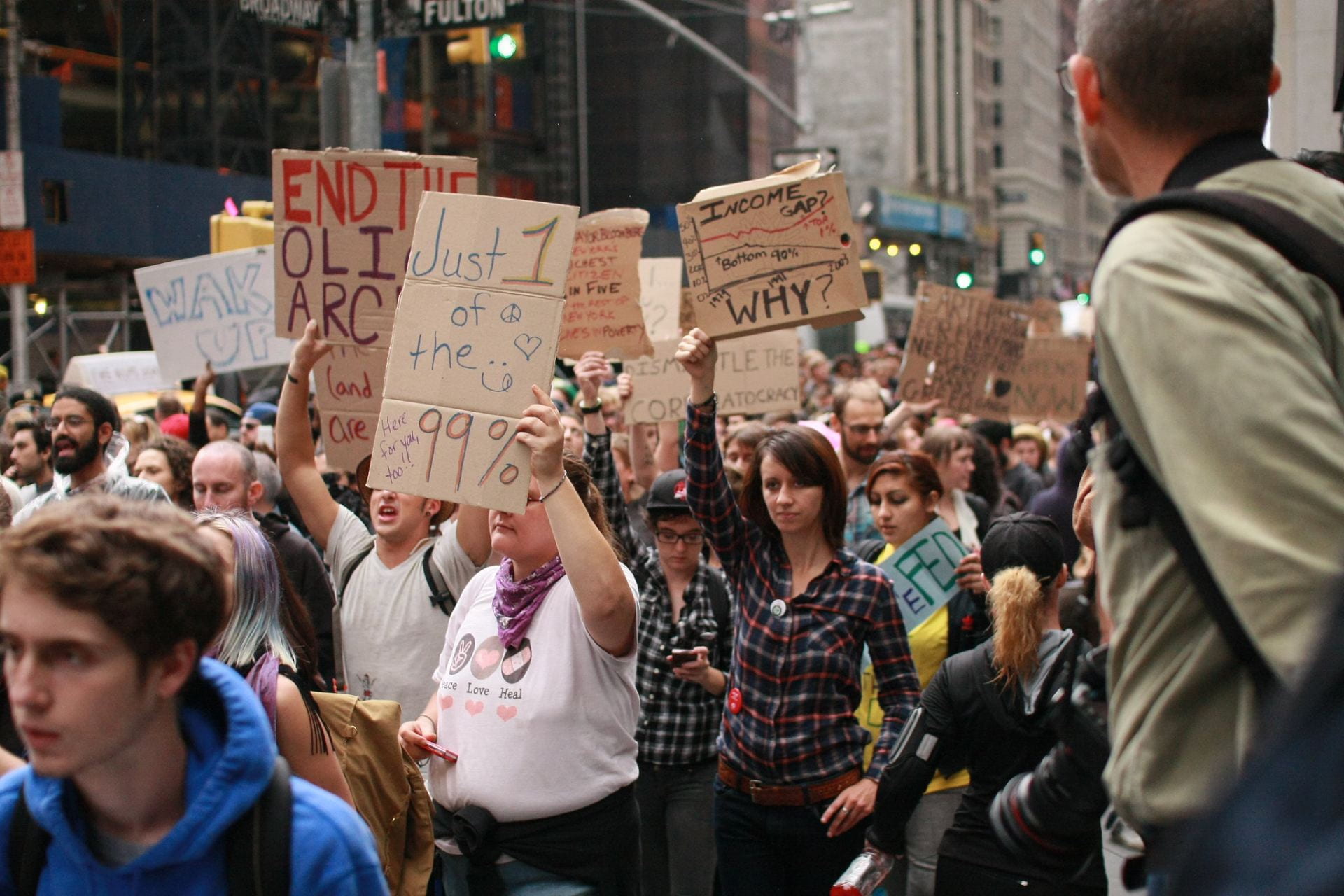
But writing is about exploring the rich fullness of the human experience. Let’s do a little experiment. Look at this photo:

Now at first glance, you probably think it’s some sort of woke mob. You don’t really think of these people as individuals, nor do you consider their individual motivations. “They’re just trying to steal from hardworking billionaires,” you might say to yourself. Some of the more sociopathic of Stories’ Matter viewers might fantasize about following one to their home, strangling them and watching the light go from their eyes. But most of you would probably be fine tear gassing them so they disperse and you can drive to yoga class unimpeded.

But as a writer, use this as an exercise to practice humanizing others. Pick five random people and write a few paragraphs of background.

This woman, for example. Let’s pretend she’s not very politically active but is here to impress this man. You see, last week she first saw him at Whole Foods when he asked if she knew where the arugula was. He was so hot she got tongue-tied and just silently pointed in a random direction, and in fact, she didn’t and still doesn’t know what arugula even is and hopes he doesn’t ever bring it up again. Anyway, she followed him out of the Whole Foods and was excited to learn he only lives a few buildings away so she’s been spending the past few nights hanging around the entrance to his building hoping they’ll cross paths again. If he asks what she’s doing, she’ll say comes to that building to leave food for a stray cat. Anyway, that didn’t happen, he must work nights or something, but this Saturday morning she saw him walk with a group of people to a local protest. And so now she hopes he shouts out some funny slogan or comment so she can laugh really loud and draw his attention.

Anyway, we’ll take radical detours that seem to be pointless on this edition of Stories’ Matter.

~

Now, before we get to the tips, let’s make a clear distinction. Minor characters are not secondary characters. Secondary characters get lots of page space and are crucial to the plot; minor characters are a step below that. To give a relatable analogy, if a main character is a wife, a secondary character is a mistress, and a minor character is a Waffle House waitress from Memphis you once banged while on a book tour whose name and hair color you can’t remember, but you do distinctively remember she got sexually excited by tornadoes.

Tip 1 – Minor Characters Should Feel Like They Have A Life Outside Your Story

A minor character shouldn’t exist just to info dump, nor should their only purpose be to support your protagonist. I mean, in real life the only reason we do things for others is to achieve our own goals. At least that’s how it is for me.

There are lots of ways to do this in your fiction. Give your minor characters a memorable hobby. Hint at a secret motivation. In Blake Colby’s Blood Shot, one of the detectives is trying to solve the crime, but the other is mostly worried about whether or not his wife is having an affair.

This is something I had to learn as a boss, as well. For years, I thought of my workers as mindless drones who only existed to take me more money. But now I make it a point to get to know my employees. For example, every Monday morning, I spend two hours monitoring their social media feeds. This has the added benefit of checking to see if they’re uploading pictures of themselves holding various books from the D&E backlog like I asked.

Tip 2 – Don’t Forget to Give Your Minor Characters a “Look”

Remember, a minor character may only exist on a few pages of a 300-page novel. So you really have to make those words count. Some strange clothing choices or gaping holes where your eyes should be is a great way to grab your reader’s attention.

Try to think of some minor characters in movies whose names you don’t remember but whose look you absolutely do. If you’re anything like me, the first thing that came to mind was the chick with three tits from Total Recall.

There’s science to support this as well. Humans are bad with names, but we’ve been trained to recognize abnormal or differing appearances. This was how we learned to cast sick or genetically inferior people out of our caveman societies. At my publishing company, I remember most people by specific traits instead of names, like “big head,” “nerd face,” “wife material if she smiled more,” and “what I imagine my mom might look like today if she hadn’t abandoned me.”

Tip 3 – Give your minor character a specific role

It’s no secret that lots of books have been written. Because of this, many roles for minor characters have been established. Let’s look at a few.

First, we have comic relief. Think about the gravediggers in Hamlet. In my novel, The House on Pain Avenue, Daniel’s brother’s frat brothers serve as the comic relief. Peeing in the dean’s coffee helps lighten all scenes where Daniel’s father kicks him out of the house for being gay.

Then you have the guide. They are meant to assist the protagonist on their journey. In my novel, Deep Throat II, the titular character guides the journalists in uncovering the president’s pizza parlor child sex ring.

This Query Letter Method Has a Guaranteed 1% Success Rate!

Literary agents: can’t live with ‘em, can’t deal directly with a publisher without getting a restraining order and needing to change your legal name without ‘em.

Writers hate writing query letters for many good reasons: fear of rejection, difficulty distilling a 200,000 word novel into a few sentences, lack of confidence in your salesmanship stemming from the constant death threats you got as an eighteen-year-old telemarketer.

It’s best to think of query letter writing as toadying up to a sick relative in the hopes they’ll include you in their will. So we’ll look at how to put on our best smile and ignore that awful smell and disgusting goiter, so to speak, on this edition of Stories’ Matter.

~

Maybe you need a letter opener. Perfect for creating quick easy access to your mail and for defending yourself against belligerent guests who won’t stop complaining about the smell of your office, you can’t go wrong without a letter opener. Visit your local office supply store for more information.

Before we start, let’s look at what we want a query letter to do. A query letter needs to seduce a prospective agent into believing that you’re going to make them money. Much like a pimp would look at a young man or woman’s body, posture, relationship with law enforcement and tolerance to various illegal substances, an agent will look at your writing credentials, tone, hook and ideas to decide if your book will sell or not.

Here are the main do’s and dont’s for query letter writing.

Do: Sell yourself

Mention any previous publishing credits you have. Mention if you have an MFA. Mention any academic honors related to writing. If you don’t have any of those, and YouTube analytics tells me that’s likely, then simply lie and make them up.

Worried about getting caught. No problem: Just create phony websites for bogus publishers. Write phony press releases and create fake book review sites with very positive reviews of your phony book. Then buy some burner cell phones and list the numbers on your website. Get good at different accents in case they call. Most importantly, whatever you do, don’t be yourself.

Don’t: Reveal too much about yourself

You don’t want to share too much with the agent you’re querying or appear too chummy. Despite everything else I’ll tell you in this video, literary agents are just people like you and me and they’ll see through obvious manipulation.

When I was first starting out, I’d often make the mistake of mentioning I became a writer because a favorite aunt had wished it on her death bed. My hope was to guilt trip the agent into considering my manuscript, but I learned that came off as needy.

Literary agents, I’ve found, also don’t care about what inspired you to write this book, what you or your girlfriend look like naked, what you think the literary agent might look like naked, the models from your vintage typewriter collection, or copies of floor plans of the office where the literary agent works.

Do: Research the agent you’re querying

This is a time-consuming process and you don’t want to waste your time querying an agent who represents, for example, hardcore queer erotica when you’re writing a pastry cookbook. (Though it’s a common mistake, it turns out.)

You also want to make sure your agent actually has connections and works for a reputable agency. If your agent gave you the address of an abandoned office, speaks with a thick Indian accent, their webcam is constantly broken and asks to be paid in Apple gift cards, you might want to ask LinkedIn if Tom Everyman’s profile is legitimate.

Don’t: Forget to proofread

If you can’t get through a one-page letter without a myriad of spelling mistakes and subject-verb confusion, what’s the likelihood you wrote a book that’s going to sell. You don’t want to, for example, say that you wrote this book because your “favorite cunt requested on her death bed.”

Do: Create a strong hook

Just like your book, your query letter needs to start off with a bang. Your hook should answer these three questions. Who is your character? What do they want? What is stopping them from getting it? In my 2009 romantic comedy Just the Tip, I used this hook: Dan Stevens is a down-on-his-luck tax auditor who is forced to audit the woman of his dreams, a young waitress at his favorite Chinese restaurant. And just when he thinks it can’t get any worse, his wife starts asking questions.

Don’t: Try to sympathize with your agent

Don’t say things like “I know you’re very busy” or “I’m sure you must get tired of looking at 1000s of these every day” or “I bet you’d like a nice strong man to rub your shoulders after a stressful day.” Trust me: I’ve tried begging, I’ve tried offering sexual favors or hiring other people to provide them, I’ve tried bribing them, I even wasted a whole month getting one agent’s son released from prison.

But I’ve come to learn one thing. Literary agents are soulless automatons. Now, does the job make them this way or does it merely attract psychopaths who get off on crushing other people’s dreams, is hard to say. Either way, it’s best to think of them as a necessary evil, like a colonoscopy, paying taxes or having to sell your book on a platform owned by a company that forces workers to piss in bottles.  

Here are a few more quick do’s and don’t’s.

Do: Demand writers in your local author group give you copies of their successful query letters and do fake cry if they won’t.

Don’t: Try to stand out by sending a query letter in a strange font like Papyrus or Wingdings.

Do: If you’re querying a male agent, mention things like football and beer, and if you’re querying a female agent, mention things like menstrual cramps and Ruth Bader Ginsberg.

Don’t: Mail a query letter signed in blood to show how serious you are.

How To Write Character Flaws (without just looking in a mirror)

Look around your room right now and try to find something wrong. For example, there might be dirty clothes piled all over the floor. Maybe there are several wedges of half-eaten cheese on different tables in the room. Perhaps there are painful cysts growing in your armpits which your doctor says is likely caused by over-consumption of old cheese. If YouTube analytics is to be believed, all of these things are true.

You might think I’m a psychic. But actually I’m just a writer who, through years of hard work, taught himself to be perceptive of character flaws, in fiction and in real life. And while that didn’t stop me from marrying a woman who turned out to be a serial bigamist, it did teach me to write many complex heroes with compelling characterization. We’ll explore how to exploit our worst personal demons to earn a few bucks on this edition of Stories’ Matter.

~

No one is perfect. For writers with large egos, sometimes this can be hard to remember. Hell, as a man who was first published at 25, sports a full head of hair at 52 and has erections that last three hours and fifty-nine minutes, sometimes it’s hard for me to think of any personal flaws. But trust me, I’ve got plenty. For example, as I’m writing this article, I happen to be twirling a loaded pistol.

In any case, it’s flaws that give your characters depth, that make them relatable and memorable. But it’s important to remember that flaws are always internal, never external. So having an alcoholic mother or living in Ohio aren’t flaws, depressing as they may be. We’ll start by looking at different kinds of flaws and analyze some classic examples from fiction.

~

Minor Flaws

For starters, we have minor flaws. These are often unique or memorable, but don’t have any real impact on your narrative. Indiana Jones’s fear of snakes is a classic example of a fun, humanizing flaw. In my revenge novel set in Georgian England, Bride of Prejudice, Leeandra has a hideous scar that runs from her right temple to her left tit. It’s a unique character trait but doesn’t really affect her or her arc in any way.

Major Flaws

Then, we have major flaws. These are catalysts for action and they drive the story. For Holden Caulfield, it’s his self-pride and inability to cope with his trauma that sets him at odds with everyone in the story. For Kable Anderken in Blake Colby’s Blood Shot, it the memories of missing free throws to get an 8th seed in the playoffs that haunt him.

Fatal Flaws

Then, we have the fatal flaw. These either make or break the character. For the hero, the whole story might be about overcoming this flaw and for the villain, it’s often their downfall. Ahab’s obsession for revenge and Humbert Humbert’s pedophilia are classic examples here. And in the sitcom, Heil Honey, I’m Home, it’s Hitler’s lack of social graces that ruin the dinner party.

Now let’s look at some ways to construct our own character flaws.

Step One: Create Relatable Flaws

If you want your reader to connect with your character, there’s nothing better than making them relatable. Think of common flaws that most people have. Maybe your character masturbates 10 times a day.  Or maybe they’re bad with money, spending half their income on antique guns.

In one of my early stories, Zero Point Infinity, one of the characters constantly tries to kill himself but is thwarted at every turn. Almost every reader I talked to, most of them millennials, felt like this spoke to them on a deep personal level.

Step Two: Don’t Get Preachy

This is especially important when writing villains. Like a bartender or the guy who cleans the elevators in the Aruba Holiday Inn, a fiction writer shouldn’t moralize. Your writing loses its effectiveness if you don’t let your characters beliefs and actions speak for themselves.

In Crime and Punishment, for example, Dostoyevsky isn’t concerned with the moral implications of what Raskolnikov has done. He’s just trying to tell an exciting murder mystery.

Step Three: Create a Balance Between Positive and Negative

Saints and demons aren’t interesting. The worst of us have our virtues and best have our flaws. Hell, Hitler was a vegetarian and Steven Seagal donates to environmental causes. And then there’s Mister Rogers, who somehow thought children wanted to look at this fucking thing.

Complex and three-dimensional characters should be balanced. Like how Sherlock Holmes’s brilliance is balanced by his lust for cocaine. Or like how the dumbass clones in Never Let Me Go’s generosity is balanced by their inability to realize they ought to just go on a rampage and murder everyone.

Step Four: Use Flaws to Create Conflict

Think of any drama you experienced in real life. It was probably caused by a personal flaw. Maybe you got in a car crash because you really liked the way you looked in the rearview mirror. Maybe you lost your job because you’re so fucking dumb you thought the world’s most obvious conman really was looking out for what’s best for you. It could be anything.

In fiction, flaws like these should drive the narrative. Recklessness might get your hero’s friends killed. Callousness might tear a friendship apart. In basically any noir, being a thirsty simp for crazy strange is nearly always a catalyst for destruction. In my drama Storming the Gates of Heaven, the prejudice of the protagonist gets the story in motion. Karl Eichmann shoots a Mexican that he thinks is trying to illegally enter the US, only to find out that Grand Canyon isn’t actually located on the border between Mexico and the United States.

What Hiring A Prostitute To Pretend To Be My Ex-Wife Taught Me About Writing Romance Novels

I have some bad news for fans of the channel: John Lazarus is no longer in a relationship. The prostitute I’ve paying to look, act and talk like my second wife has decided she’s no longer willing to provide me with her services.

It’s a tough thing to say goodbye to someone you still love. All those happy memories we shared — dinners together, movie nights, meetings with plastic surgeons and dialect coaches – just bring me pain and sadness now.

Unfortunately, Destiny decided it was time we moved our separate ways. So much time spent pretending to be someone she wasn’t caused her to lose her own sense of identity, it seems. Once she started dreaming as my second wife, she knew it was time to give nursing school another shot.  

As a romance writer, you will similarly construct a romantic identity for your characters in much the way I did for Destiny. In this article, I will show you how the mistakes I made with her are probably very similar to the mistakes many aspiring writers make when attempting their first romance novel. We’ll try to stop glamourizing underage relationships on this edition of Stories’ Matter.

~

So, if you’re new to the channel, I’ll just give you a little bit of background. I have been married three times in my life, but my second wife was definitely my favorite. But that’s not just because my first wife was a serial bigamist who was already married to several other people, or because my third wife was my therapist who used hypnosis and other forms of psychological manipulation to make me fall in love with her.

Cindy was simply a wonderful woman. And I’m not just talking about a pair that defied gravity or the fact that she introduced me to pegging. Cindy taught me how to cook. She convinced me to start my own publishing firm. She was instrumental in removing my dad from his burial plot, selling the plot to fund a down payment for a new house and then dumping him at sea. She was also the only woman I never cheated on.

But unfortunately, this storybook romance wasn’t meant to last. We parted after two short years together. While my love for her remained strong, she didn’t feel the same way. I’ve had over a decade to wonder what went wrong. Perhaps I was too wrapped up in my writing. Perhaps I was too clingy. Perhaps the fact that her new husband was taller, younger, richer and had more friends than me was my undoing.

In any case, that’s not especially important for the purposes of this article. Because I’m actually here to talk about Destiny, the escort I’ve spent the past six months forcing to look, talk and act like Cindy.

Step One: Forcing Chemistry Instead of Building It

This of course relates to our key writing rule: “Show, don’t tell.” You can’t tell your reader that your characters are in love, you need to show them interacting in an organic way that shows them building chemistry.

If you want to write a story about a reformed Islamic terrorist who falls in love with a female Silicon Valley CFO, that’s fine. “Opposites attract” is a great trope. But you’ve got to find a way to make their connection make sense. Perhaps they slowly bond over their love of Colin Firth movies or something.

Looking back, I realize I forced things with Destiny. The speech therapy is one thing, but making her listen to tapes of Cindy’s voicemails while she slept was too much. Maybe I could’ve called her Destiny on Mondays-Fridays and only forced her to pretend to be Cindy on the weekends.

Step Two: Making One Character Passive in the Relationship

Relationships aren’t about one person seizing control and making all of the choices; this isn’t the state of American democracy in 2025.

And this isn’t just a problem with male writers. You’d be surprised how many manuscripts I get from female writers whose male love interest in their novel is basically a dildo with nice hair who also happens to be a ghost.

I now realize I should’ve given Destiny more agency in our relationship. I should’ve let her choose her own restaurants instead of screaming that “Cindy didn’t like Italian.” I should’ve let her buy that boat even though Cindy was terrified of water because her brother drowned when she was five.

Step Three: Writing Relationships Without Commonalities

Your characters need to be together for a reason. Sure, in real life, people might be put together solely because they’re part of the Chinese government’s attempt to create a superrace of excellent basketball players, but your reader wants your couple to bond over something they share.

They shouldn’t be carbon copies of each other, obviously. They don’t have to love the same music or types of porn. But you still need to make that connection. In my novel Above the Rim, it was shared sexual experiences in basketball arenas. In Heartland, it was the shared belief that 9/11 was an inside job.

When I followed her on her days off, I saw that Destiny was into gardening and visiting her family and volunteering at a dog shelter. Those are all things I wouldn’t dream of doing.

Step Four: Not Allowing For Vulnerability

Human beings are frail things. We aren’t like the common salamander; we can’t survive if our head gets cut off.

It’s important that both members of your couple show weakness and fragility. For example, maybe she had both of her hands chopped off by a helicopter. Maybe he’s a control freak who wiretaps everyone, even his best friends and himself.

It’s clear I expected Destiny not to be the perfect woman but the perfect approximation of Cindy. And I expected myself to be perfect as well. One time, I accidentally called her Destiny while we were having sex. This was particularly egregious because I usually only shout my own name during sex. Anyway, I locked myself in a room for a day after watching home movies of Cindy and I.

Step Five: Having Contrived Conflict for the Sake of Conflict

I mean, sure, in real life couples fight. They slap each other. They throw drinks in each other’s faces. They break each other’s garage doors. They sneak devices that emit chirping sounds once every five minutes under their bed and pretend they can’t hear the sound. That’s all fine and normal.

But in your story, conflict must arise organically. Characters need to remain in character.

After Destiny and I settled into our groove and she really got the character of Cindy down, I tried to reenact a fight Cindy and I had several years earlier. The problem was, because of Destiny’s profession, she was cool with taking a cumshot anywhere. So she wasn’t able to channel Cindy’s rage. The next two days of silence and the following “make up” sex just felt so forced.

Step Six: Portraying Abusive Behavior As Romantic

While this doesn’t really relate to my situation with Destiny, you should try to avoid this. I see this way too often in romance novels.

Your Guide to Book Publicity (that’s legal in most countries)

From the moment we’re born, we simply want one thing: to be recognized and acknowledged. As we go through life, our end game passes from breastmilk to star stickers to disappointing, booze-fueled sexual encounters, but the underlying need to have our existence recognized never changes. For writers, who are often neglected and emotionally stunted, this need is even stronger. Our stories are there to do what our flabby bodies and off-putting personalities never could. All of this is to say, a good publicity campaign can help prove your life wasn’t a complete waste of time and therefore is a fairly important skill to have as an author.  

However, book publicity isn’t like a son or daughter’s graduation party; you can’t just scream and cry until people pay attention to you. It requires planning, connections and a strong awareness of your strengths as a writer. We’ll lie about our background and make empty promises on this edition of Stories’ Matter.  

~

Finishing a novel is one of the most bittersweet moments in life for an author. On the one hand, you’ve finally completed something that’s taken you months, maybe years. There’s this concrete product into which you’ve poured your blood, sweat and tears. On the other hand, you worry that nobody will ever actually read it and it may not have been worth neglecting things like your job and family, who, come to think of it, you haven’t seen for weeks. 

But with a proper book publicity plan and media pitch, you can relax a bit. Even the most obscure, unappealing book that’s self-published can sell in today’s market with the right publicity. To prove this point, I’ll take you through how I marketed my neo-noir thriller Sam I Am, a story about a man with Down’s syndrome who helps the police catch a famous serial killer.  

Step One: Make it About Yourself

As you might’ve noticed from this channel, I hardly ever spend any time talking about my actual books, but focus on my personal life, everything from the fire that destroyed my publishing company to why my second wife was the most exciting woman I’ve ever been with sexually. My most faithful viewers have probably learned more about the ins and outs of restraining orders than they have about plot structure. However, I do this for a reason and not just because making these videos is cheaper than therapy.  

We’re much more drawn to people than we are to books. For example, most people relish the fantasy of having a drink with Hemmingway or watching the Fitzgerald’s belittle each other than actually reading any of their books.  

So let your fans know about you and your expertise. And this is a point I’ll keep coming back to: It’s okay to lie. When I wrote Sam I Am, my book publicity materials said I was inspired by my son Jefferson, who had Down’s syndrome. Personal connections like these will endear your audience to you. Truth told, I’m not quite sure what was wrong with Jefferson. 

Step Two – Give Expert Interviews

With all this in mind, it’s important you get yourself out there. And one great way is to give expert interviews to the media. You could do book blogs. Write personal essays for online magazines.  Local TV news is desperate to fill the air with something that isn’t tips on how to pack a suitcase.  

Now, you might be thinking, John, I’m not an expert in anything. Who will want to listen to me? Fortunately, you’re in luck. We are currently living in a golden age for dangerously unqualified people pretending to know what they’re doing.  

For Sam I Am, my big boost came from an interview I gave with a local radio station where I claimed people with Down’s syndrome have been unfairly maligned and marginalized and with the right care and guidance they can and have assumed many professional roles in our society. Of course, I didn’t know any of that at the time and was just making it up, but it turns out I was actually right.  

Step Three: Offer Special Giveaways and Promotions

Fans of the channel know I don’t believe in giving away anything for free. Hell, because of all the free copies of Sam I Am WKXP made me bring to their studio for my interview, I made sure to raid their green room. I even took the boxes of disposable forks and knives from the cupboards.  

But there are workarounds. You can have a flash sale that lasts only thirty seconds and if people complain, just say you had your clock set to Burmese time. To entice readers, post free versions of your book online but with every other word redacted.  

Here are some other useful tips: 

Put subliminal messages in your Tik Tok or YouTube videos 

Get plastic surgery to make yourself more camera friendly 

Hint that your book will help your reader get laid  

Fake a British accent to make yourself sound more intelligent 

Mail your book to media producers. And use unmarked packages to make it more of a surprise.  

How to Write Diverse Characters (that even racists and misogynists will love)

Whenever I start my writing workshops at the learning annex, one of the first questions students always ask me, after “Is this class fee refundable,” is “Is it okay to write about characters of a different race or sexual orientation?”

It’s a tough world out there right now. In addition to worrying about honing your skills, trying to get your name out there and getting cease and desist letters from your family to stop putting personal information about them in your YouTube videos, you also have to worry about getting cancelled.

You might feel like you wrote the perfect first page, one that was poetic and enticing and instantly draws the reader into your unique world, but after you think more about it, you get anxious that the woke mob will go after you for using the N-word six times.  In today’s video, I’ll show you how even the straightest, whitest Oberlin graduate who grew up in the suburbs of Indianapolis can write about any race, creed, gender or sexual identity. We’re going to put on our metaphorical blackface on this edition of Stories’ Matter.

Race, religion, LGBT issues… lots of writers want to shy away from these topics. But the whole reason you’re a writer is to explore the unexplored and represent the underrepresented. We need more books about unique people and unique perspectives. Plus, it’s unfair to ask writers to limit their writing to their own personal experience. If that were the case, nobody from Omaha could ever succeed because who the hell wants to read a book set in modern-day Nebraska?

Before I get to the advice, I want you to relax. Acknowledge your discomfort, but be open to everything. We’ll never make any progress if we embrace our ignorance. Don’t be afraid to ask stupid questions in the comments. Men, don’t be afraid to ask our female viewership how a vagina works. Black people, don’t be afraid to ask our Chinese, Japanese and Korean viewership what the different slurs for “blacks” are in their native language so you can finally know what those people at the laundromat are really saying.

Step One: Do your research

As with anything else you write, a good story begins with great research. Don’t even think about race, gender or identity for a minute. Pretend you’re a Mormon who wants to write a book about an alcoholic. How would you go about doing it? Now, if it were me, I might do a few different things. I’d watch home movies of my father. I’d attend local AA meetings under false pretenses to get ideas. I’d hang out under a bridge at night. And in fact, these are all things I did when I wrote Plastered Bastard, a revenge thriller about a serial vehicle manslaughter perpetrator.

So when you are writing about another race, you need to come to know that race very well. Do the things you might think a person of that race does. Listen to recorded speeches of beloved political leaders, for example. Watch gay porn. Watch anime. Email your manuscript to someone in your office of that race, even if you don’t know them very well, to get their input. And if they’re a janitor without an email address, print out a copy and put it in their utility shed, as I’ve often done.

Step Two: Describe Your Characters in Detail – When I was teaching at the learning annex, I can’t tell you how many people would give me vivid, detailed descriptions of their white characters while the minority characters were just Black or Asian and the reader was supposed to fill in the blanks. Whenever I came across this, not only did I make this person write an apology to each member of the class, but I also made them wear a sandwich board that said “Ignorant Racist” for the rest of the lesson.

Let’s take an example.

Look at this woman. How would you describe her? Would black suffice? I don’t think so. I would describe her body as voluptuous and her lips as pouty and full. I would say that “her hair was shiny and silken and I wanted her to stand over me, completely naked, bending down and dangling the hair so it was just gently tickling the skin on my chest until I reached orgasm.”

Step Three: Don’t Be Ambiguous

For a writer, specificity is everything. In addition to your descriptions,  this also applies to your diverse characters’ backgrounds. Your character should never just be Native American or Mexican. Are they from the hills of Sinaloa or the slums of Juarez? It doesn’t just apply to race. When I write gay men, the first decision I have to make is if he’s a top or a bottom. Then I ask, Does he generate the power or is he just receiving the power? Does he prefer reach arounds or is he willing to let the release come of its own accord?

Step Four: Avoid Savior Narratives

At the learning annex, I used to have this one student. We’ll just call him Jeff Stanley Wilson. Though he was an older guy, he was about as woke as a boomer gets. He followed all of the above rules pretty well and created some diverse, three dimensional characters of color and other sexual orientations. But Jeff’s problem was his heroes were always white males. And they also were described exactly the way he looked, bald head, glasses and six foot seven. And they were also all named Jeff Stanley Wilson.

I always told Jeff that he was limiting himself as a writer by doing this. Sure, like Jeff you may write as a kind of wish-fulfillment to forget that your wife left you and your son was killed by a drunk driver, but it sends the wrong message to say that people of color rely on whites to be saved. And it’s just not very true to life. I mean, look at… all of history.

Blood Shot: Chapter 3 (By Blake Colby)

“What does that hand gesture mean?” I asked Carter.
“He’s challenging you to a fight.”
“Oh!” I had never been great at picking up nonverbal cues. It was by far my worst subject in school.
I’m not sure how much time went by: forty-five or possibly forty-six seconds. I walked to my car. A light breeze passed over me.
I paused for a moment, closed my eyes, and lifted my face to the sky. I took a deep breath. I thought about Jennifer. I thought about Terrald. I thought about Fran in her hotel room in Wuhan, waiting for me, constructing my likeness out of pillows, lamps and assorted vegetables and laying it on the hotel bed beside her.
I sifted through my car’s glove compartment for anything useful. Recalling the coach’s challenge, I grabbed both my switch blade and tire iron, as well as pepper spray and bullets. I remembered I forgot
my gun on the shelf above the urinal in the boy’s bathroom, but looking toward the gym doors, I could see the coaches blocking my way back inside.
From a distance they may have seemed a threat: four athletic, muscular men, none under 6’6”, wielding chains and wooden sticks embedded with shards of glass. But I’ve been in many fights in my life. I’ve taken on white supremacist biker gangs, rogue Mossad agents and Comcast Cable representatives. This on the other hand was amateur hour, through and through. For starters, none of their weapons were even monogrammed.

Shortly thereafter, I saw Carter run out of the same door. I half expected him to start hurling knives into the backs of the four coaches, as he was wont to do. But he just snaked through the rows of cars, taking in the evening air.
I was standing outside my driver’s side door when the men stopped.
“Great game tonight,” I said.
“Heard your lady raggin’ on you for defending her boy,” the head coach said.
“Heard her call you out for being a touchy-feely little pussy,” another assistant chimed in.
“Heard she’s moving to Arizona on account of the emotional distance you keep her at,” a third echoed.
The head coach started speaking again. “We figured you’d bitch out and not show up. Thought we’d get this done as soon as possible.”
The head coach took out a small razor and made a cut on his upper cheek.
“Just think: If this is what I’m willing to do to myself, imagine what I’ll do to you.”
A classic mistake. The head coach probably had little fight experience. Most of the time all he needed were cheap theatrics like this (and his foot and a half height advantage) to scare his opponents into submission. I looked over for Carter. He was still ambling nonchalantly, keying random cars. (Carter drove a Bugatti Veyron – in his mind, he was doing these people a favor.) I would have called out for help, but I knew that, one, I didn’t need it, and two, Carter would’ve understood it was just a scrimmage. The head coach took another step forward.
“So did you choose?”
“You mean between tire irons and switch blades? Why not both?”
“Oh, I’m starting to like you.”
“So whip ‘em out. Let’s do this thing.”
“Too many people around here. Plus, it’s starting to sprinkle and I don’t want to get my hair wet. There’s an abandoned meat processing factory next to the football field. No one will bother us there.”
Carter finally joined us.
“How, pray tell, do you know about this warehouse?” he said.
“I went to high school here. Our football team had a lot of postgame parties in that warehouse. You could say it was the secret of our success.” He proudly puffed out his chest.
(I was oddly reminded of a local news scandal from about thirty years ago. In the winter of ‘85, local police discovered the decapitated heads of ten district star quarterbacks – all but Eichmann High’s – in a nearby river. The boys each went missing exactly one week apart from each other. Around the same time, Eichmann High had its infamous school cafeteria human meat scandal. Unfortunately, in both cases investigators failed to produce any leads.)
My thoughts returned to Jennifer. I knew she wouldn’t want me to put myself in a situation where I would hurt someone. Hell, even I didn’t want to. I’ve been around enough violence to know there’s no glory in it.
“We’re two mature adults,” I finally said. I strained to get the words out. “There’s no need to resort to violence, right?”
The big smile stretching across Carter’s face as he rubbed two knives together disappeared. I knew he’d be disappointed, but I could always make it up to him.
“Just as I thought,” the head coach said.
I turned around and started to walk away. But then I heard it. I heard the sound. The sound I hear in my nightmares. The sound I can never run or hide from. The sound that haunts me.
One of the assistants had a tape recorder in his hand. To anyone else, it would have just been a springy metallic clang. But I knew it was more, a sound of a sinister origin: It was the sound of my free throw shots bouncing off the rim and costing my team the eighth seed.
We all have our weaknesses. For some it’s the bottle, for others a deck of cards. For Carter, it’s something called a Brazilian piledriver. But whatever it is, its presence causes a synaptic malfunction that renders us incapable of saying “No.”
I turned back to look at the coaches. “Take me to your goddamn warehouse.”


The six of us crossed the football field and entered the warehouse. For an abandoned building, it was in good shape. It seemed a few enterprising students had converted one of the wings into a successful meth lab. There were plenty of lights on and a couple of guards were sleeping near the entrance.
My change of demeanor sent Carter into a fit of ecstasy. He and the three assistants waited on the factory floor while the head coach and I ascended the catwalk overlooking the giant meat blender.
We reached the area directly over it.
“You’d be surprised what this thing could do to a human,” he said to me.
“I imagine it cuts their flesh and bones into tiny pieces very quickly.”
“Lucky guess.”
Down below, the three assistants surrounded Carter.
“Gentlemen,” Carter said, “a quick word before they commence.”
“What the hell do you want?”
“Simply to issue a brief warning. While it may appear that the number and territorial advantages reside with you, I must reiterate that…”
The head coach, tired of listening to Carter babble, turned on the meat blender.
Unfortunately, dear readers, it’s here we come to a sad truth. While in movies and TV, heroes and villains often monologue and deliver punchlines over the gentle humming of industrial machinery, in real life it’s simply impossible. The deafening noise of the giant motors required to spin three-meter-long blades at 300 RPMs render any kind of dialogue inaudible. (Still, I’ve tried my best to transcribe what I heard over the course of the next few minutes.)
In any case, the noise wasn’t a factor at the moment. I only had one sound in my head: those free throws clanging off the rim. Rage consumed me. I knew it was a mistake to fight this way. You need to keep your adrenaline flow under control, otherwise the other guy could easily pin that soft flesh of yours against the smooth tile of the locker room floor.
I looked at the head coach. For the first time all night, I saw a glimmer of hesitation. Perhaps he realized knife fighting a total stranger over a giant industrial meat blender just to prove a point that you have a right to be verbally abusive to an eight-year-old kid wasn’t the best idea.
The coach led with the hand holding the blade; he twirled the tire iron in the other. I held my ground, flexed my knees and bounced on my feet to stay loose. He threw a few jabs with the knife toward my right side. I easily blocked them both with a quick swing of my tire iron. The coach stumbled backward, his clumsy movements not surprising.
“I’m gonna bill you!” he shouted in anger.
“What?!!” I yelled back.
“You’re wed. Your whole family’s wed. Your son and girl and your friend are all wed.”
“We’re not polygamists.”
“What?!!”
We traded blows for a minute or so. I was only going sixty percent, trying to gauge the coach’s technique. I drove the tire iron hard into his left wrist, causing him to drop his knife to the factory floor. It may sound immodest, but the coach literally had no chance.
True athleticism is almost 100 percent genetically predetermined. Sure, athletic organizations perpetuate the myth of grown athletes to fill their own pockets, but the hard truth is it all starts in the womb. A simple DNA test can determine whether or not a child will be an athlete. In reality, none of my NBA teammates or I ever had to jog or lift weights.
The coach leaned over the rail to catch his breath. He glanced down at the spinning blades below and smiled. I watched a spark of inspiration flutter across his face. He looked at me, took a deep breath and starting spinning both of his arms in a windmill motion.
I used the opportunity to search for Carter below. He was looking for an outlet to charge his phone. The three assistants lie where they had just recently stood, each with a shiruken embedded in his forehead.
The coach continued his slow approach.
“I’m going to read you to those rye stool lids just like I hid when I was a rude dent.”
“I can’t hear or understand you.”
“Do you even grow stew for dressing with?”
“Ummm…yeah. Mmm-hmm.”
“I bone this gown.”
His arms picked up speed. But I saw I had an opening. With one quick snap of my wrist, I threw my switch blade into his exposed torso. The blade plunged directly into his belly button. The coach stopped spinning his arms and fell backward. He grabbed at the knife’s handle and cried out in pain.
“Please, yelp me! I don’t have wealth for hermits!”
I should have let him fall. I should have put him out of his misery. But by now the sound of the rim clanging had dissipated. My rage faded. I looked at the poor man in front of me wincing and pooping himself and trying to seal his wound with poop. And I felt sort of bad. I gave him a couple quick kicks to the face to knock him out and then dragged his unconscious body down to the factory floor where I rejoined Carter, who switched off the machinery.
Looking at the three fallen assistants, I said to Carter, “Tell me you didn’t lace those things with cyanide.”
“No, no. They should come to in a few minutes with nothing more than a real bad headache. And perhaps a newly-acquired speech impediment.”


We left the warehouse without another word. I got home an hour later to three new messages on my answering machine. But I accidentally deleted them so I have no idea what they said. I soon got a pair of phone calls. The first came from Carter.
“We might have a situation on our hands,” he said.
“What is it?”
“Those guys we attacked. It turns out they’re of some renown in the local chain of command.”
“What, did I stab the president of the city?”
“Mayor. Cities have mayors.”
“What am I, a civics professor?”
“Anyway, no. But the guy I popped a shiruken into, and whose hand I later left sitting in a bowl of water, is the city comptroller.”
“They started it.”
“In any case, I think a short weekend in Thailand while my lawyer figures out the details would be well advised.”
“I’ll think about it.”
I hung up. Carter was right – it would be wise to lay low until the heat died down. But I only had a few moments to weigh my options before the obvious answer presented itself. Another call came in.
“Come to me.”
It was Fran. One short conversation and a change of socks later and I was on my way to the airport. I approached the ticket counter.
“Any room left on the 9:30 to Wuhan?”

I Wrote 51 Books in One Year… Here’s What I Learned

If there’s one mistake I’ve made in this series, it’s that I haven’t told you enough about myself. Any asshole can get on the internet and give you writing advice with zero credentials. Why should you trust me?

After all, I don’t show my face and I use a pseudonym and, if you listen closely, I frequently have the faint sounds of screaming in the background audio of my videos I can’t edit out. But the truth of the matter is, there’s a lot to be learned from my twenty-five years of experience as a writer, from both my successes and my failures.

In today’s video, we’ll take a deep dive into the most productive year of my career and I’ll share the things I learned about productivity, the elements of fiction and crippling drug addiction. And if nothing else, you’ll be able to identify the warning signs that someone is secretly poisoning you. Let’s ink up our pens and put on our writing gloves to prevent pussing blisters on this edition of Stories’ Matter.

~

Let me set the scene. The year is 2008. The global financial crisis had displaced thousands of hard-working investment bankers and hedge fund managers. America was well on its way to electing its first half-Kenyan president. And Hawthorn had shocked the world and won the AFL grand final.

This was about one decade into my career. As fans of the channel will know, the very beginning of my career was bumpy. I made the rookie mistake of working with the first publisher who would have me, a fringe publisher with no offices who wanted to publish my series of novels about serial killers who brutalize women for all the wrong reasons. And then my second publisher, while more reputable, had set it up so I lost money on every book I sold.

Then, in 2003, into my life came Tabitha Cartwright. Because of certain legal agreements, I can’t go into too many specifics about our relationship, but despite how things ended, it was certainly the most fruitful collaboration of career. She was, just to give an example, the first person who told me I shouldn’t endow all my female characters with DD breasts.

I finally was able to write a book that sold more than 1000 copies. And I grew immensely as a writer, with a much better understanding of narrative convention, how to market my books and myself, how to speak to publishers. Soon, I was churning out books like L. Ron Hubbard possessed by the spirit of Xenu himself. In the final year, 2008, I wrote 51. Here’s what I learned:

Lesson 1: It all starts with a strict routine

As a writer, it’s not enough to want it. You can say you’re determined all you want. The junkies at the support group I’ve joined under false pretenses to get ideas for my writing say it all the time before they inevitably relapse.

But having a strict routine enforces determination. You can see my video on my writing routine here. To paraphrase, you should design a routine that provides the following things: time to write, ways to make writing your happy place, time to edit and…

Lesson 2: Punishment for not following your routine

You can’t let life get in the way of a good idea. Think of what our world might be like if Einstein hadn’t been absolutely revolting to his wife so he could focus on his work.

But it’s not enough to miss recitals or funerals and stay home to write. You need a concrete method for making sure you meet your deadlines. Some people might hook up car batteries to their body and their alarm clock, but I’m not a science guy. As I told you in my writer’s block video, the most effective way to stick to a deadline is to hire ex-cons to inflict physical punishment for missing deadlines.

I got the idea from my loan shark and it worked wonders. Make sure you set clear rules and boundaries. Obviously, you don’t want your fingers broken or that would defeat the whole purpose. But if they rough your face just enough to avoid needing to see the doctor, you’ll find yourself motivated.

Lesson 3: Make sure your POV is consistent

Lots of writers worry about plot holes or creating snappy dialogue. But almost nobody realizes the importance of having a consistent POV that serves a specific function.

Maybe it was because I was writing 15,000 words every day and only getting up when I hallucinated that somebody was knocking on my door, but I would slide between third-person omniscient and third-person limited often.

Lesson 4: Big ideas are more important than details or spelling errors or turning in your final manuscript on the back of horse race pick slips

Whether you’re writing for thirty minutes a day after work or you’re writing all night just to avoid you sleep paralysis demon, keep in mind that publishers and consumers care about the big picture. A unique hook will draw more readers than a completely unfinished chapter will push them away. At least with the latter, you can disguise it as a metaphor.

Lesson 5: There are a lot of legal amphetamines

So after Book 30, even I was a little surprised by my own productivity. I mean, I knew story structure in and out and I also didn’t have to cook or clean or bathe myself because Tabitha had hired a maid to do all that for me.

I was always driven and never had the most normal sleep patterns, but it did seem strange to be awake for 72 straight hours and then crash for the following 16. And it turns out the aspirin the maid was giving me was actually an amphetamine responsible for my loss of sleep.

When I confronted Tabitha, she said it was legal, took me to the pharmacy where she bought it and said it was no different than putting her dog’s heart worm medication in his biscuits.

If I wasn’t so horribly addicted by that point, I probably would’ve gotten mad.

Lesson 6: Sleep Deprivation can lead to memory loss

Just like a porn star and calculus teacher, a writer needs to know their limits. Mine were thrust upon me. Books 32 to 47 are all lost to memory. The only evidence I have of those few months is the final product of 15 very poorly written novels and a very terrible Bernie Madoff Halloween costume.

I’m pretty sure I stopped taking the drug at some point during this period only due to the fact that I am not dead. To this day, I’m still not sure if was through sheer willpower or if Tabitha simply realized my books weren’t selling enough to pay for the pills, the maid and the baby I somehow put inside her.

Anyway, if you’re going to write 51 books this year, make sure to take care of your physical and mental well-being.