Why Men Aren’t Reading… And How You Can Win Them Back

There’s an uncomfortable truth about the world of fiction in the 2020’s: men are no longer reading fiction. It’s an epidemic almost nobody is talking about, except for the 50 or 60 book blogs and news websites I used to research this article.

While this could be great news for virile, heterosexual male authors looking to score some easy strange at book signings and literary conferences, it’s also a market all fiction writers, male or female, need to win back.

And it’s not just readership. In fact, the entire industry is becoming more and more dominated by females. Fifty-eight percent of literary agents are women, and at some publishing companies nearly seventy-five percent of the staff are female. It was such a big problem at D&E Publishing I had to lay off many of my female editors and copywriters and hire my unqualified nephews to do the work. Things have gotten sloppy, but with the money we saved on paternity lawsuits, it’s about evened out.

So you might be wondering: how did we end up here? Well, there are a lot of theories. Some think radical feminists at literary houses are punishing straight males by not publishing traditionally masculine work and therefore keeping the things male readers want out of bookstores. But I’m not sure about that. After all, my self-published political thriller, The Annapolis Affair, has everything a straight male reader could want: a love interest with j cups who’s also double-jointed, extreme violence against minorities, a protagonist with a dead wife, a second love interest also with j cups. But of the 50 or 60 males I gifted the book to, less than 10 percent proved they read it when I quizzed them on it later.

So what else is happening? Well, some think that there’s just have too much competition from other forms of entertainment: Netflix, video games, pickleball leagues, online gambling, and about every type of porn you could imagine. Some think men just don’t have the time. In this economy, most men have to work two jobs and host their own podcast just to pay rent.

And let’s not forget the social component either. For women, reading can be a shared experience and book clubs are another thing that’s become more and more dominated by women. As a man, I’ve never felt comfortable or accepted at a book club, though in fairness, that could be because in the last book club I joined,  I was sleeping with two different female members.  

In today’s article, we’ll look at some ways fiction writers can try to coax male readers back into the fold. We’ll go beyond graphic depictions of sex and violence on this edition of Stories’ Matter.

~

Tip 1 – Keep it Short and Sweet

Today’s fiction has ballooned in length. Average novels are around 100,000 words. Sci fi and fantasy series books often extend past 150,000. As we said, men are busy creatures who can’t invest all their time into your work.

It wasn’t always like this. A few generations ago, the fiction of writers like Ian Fleming, James M. Cain, and Mickey Spillane was about half that length. A man could finish a single novel in a day during his train rides to work, his late morning and early afternoon scotches, and his early evening post-coital rest so long as his secretary or mistress didn’t get too chatty.

Writing a novella between 40 and 60 thousand-word might be just what that potential male reader needs. A writer who’s also a good editor will know where to make cuts. For example, get rid of your adverbs, always move the plot forward and don’t describe the setting that scenes take place in. If all else fails, simply remove the dialogue and inner monologue of your female characters.

Tip 2 – Be Relatable and Yuk it Up

It’s a depressing time to be a male. I’m not going to waste time trying to analyze or solve the male loneliness epidemic. All I will say is you writers should absolutely exploit that loneliness for your own gain.

You should write protagonists that your reader could be friends with. God knows they’re desperate for one. Steer away from complicated antiheroes or virtuous superheroes. Write characters who feel like a hilarious, fun-loving neighbor, instead of a real life neighbor who constantly disputes your property line and then has the gall to come onto your property uninvited and drown in your pool.

Tip 3 – Serialize

So many writers want to write the next great American novel. They want to write the next The Great Gatsby or Infinite Jest or The Way of the Shadow Wolves. Fight the urge to be the voice of a generation. Build your name first with short, simple confident fiction. Your magnum opus shouldn’t come until you’ve grown sick of your friends or partner and want a better class of associates.

And the best way to keep readers reading more and more of your fiction is to serialize. Serialization is the most natural form of storytelling anyway. It dates back to cavemen times. Old people, having reached their thirties, now useless hunters and sexually undesirable, had to find ways to keep the young people from casting them out of the tribe. Telling never-ending fireside tales that ended on cliffhangers was the only way the elders could attain food and shelter.

Fast forward to the 19th century. Most classic novels you can think of by writers like Dumas and Dickens were released in serialized segments. This was so tonic and elixir companies could advertise their most up-to-date products; ads in a long codex-format novel would quickly be out of date so publishers had no way to pay for printing costs.

In the modern day, writing short, serialized stories more closely mimics TV shows and video game levels so loved by modern men. Most men feel like shit all the time so giving them something to look forward to will go a long way.  

How to Write a Great Time Travel Story (without resorting to incest)

We all wish time travel were real. Unfortunately, it’s not possible. And I know that because I buried a note in my yard asking people from the future to travel to 2025 and help me with this video and also get me more followers, and in exchange I would provide them first-hand accounts of what the world was like in 2025 for small business owners so they could become famous historians.

However, even if it is as fictional as a loving marriage, time travel is a wonderful literary device that readers can’t get enough of. It lets us explore the nature of fate. It lets us view history through a different lens. Plus, we all make choices we regret. Time travel lets us wonder what it would be like if we hadn’t slept with that employee last year with whom you settled a sexual harassment lawsuit that tanked the value of your company and whom you also think is responsible for making sure your YouTube channel fails miserably.

Yet time travel can be a tricky thing to get a hold of as a writer. Dealing with all these logical paradoxes can be a headache.  You have to think of a good reason why a character should or shouldn’t have sex with their family member or themselves. You have to think of all the different ways people from the past were backward and bad. You have to think of a reason why falling in love with Andie McDowell would make your life better in any way whatsoever.

Still, time travel can be a wonderful playground for a writer who’s got nothing to lose now that his company is probably going bankrupt again and not even because of a fire this time. You can even use it to exorcise some demons. My time travel story, There’s No Place Reich Home, about a man who goes back in time to kill Hitler only to realize he’s one of Hitler’s descendants, came about after I discovered some Nazi paraphernalia at my uncle’s house. Interpol later explained he was the prop manager for a local production of The Sound of Music, but it still made for an interesting dilemma to explore in fiction.   

We’ll analyze past mistakes and see if some dicks can be unsucked on this edition of Stories’ Matter.

~

Tip One – Choose Your Rules and Choose Carefully

Time travel stories generally fall into three categories: stories where the past cannot be changed, stories where changes alter the future, and stories where alternate realities branch off from the main one. I can’t tell you which one to choose, by which I mean I absolutely can tell you which one to choose and it’s the alternate realities one.

The great thing about this one is that you don’t have to worry about paradoxes forming because every decision the characters make forms a new reality. Also, people have a natural curiosity about the choices they never made and the alternate lives they could be living. For example, I bet most people watching this video wonder what your life would’ve been like if you married your high school sweetheart instead of falling victim to her mother’s sexual advances. Perhaps if you found a way to juggle both of them instead of confessing, that would’ve set you off on a career as a successful minister or politician.

Me personally, I wonder what my life would’ve been like if I had been in D&E offices the day the building burned down instead of in that fugue state.

Tip Two – Pick a great trigger (and hold off on pulling it)

The Delorean. The Phone Booth. The Hot Tub Time Machine. Make your method something unique and memorable. I’d avoid vehicles as they’ve been done to death. Your method doesn’t have to be a device at all. In There’s No Place Reich Home, the main character triggers time travel by shaving his facial hair into a Hitler mustache.

But it’s also good to wait until the end of the first act to trigger the time travel. We want to know the character fairly well so we experience the shock of time travel with them. In my young adult series, The Time Thief, I set up the main character’s Roblox addiction so we experience how difficult travelling back to 2002 truly is.

Tip Three – Choose an Interesting Backdrop (And Connect it to Character)

It’s never a bad idea to pick important moments in history to visit: September 11th, the assassination of Franz Ferdinand, the day Franz Ferdinand’s indie rock hit “Take Me Out” was released.

But even more important, the time period should connect to your character in some way. In my aforementioned There’s No Place Reich Home, it was important to get the character back to World War II Germany because his friends bet him one thousand dollars he couldn’t kill Hitler if given the chance.

Tip Four – Introduce Setbacks

Like any story, you need conflict. A great way to do this in a time travel story is to make the method of time travel malfunction or disappear. The Delorean, for example, wouldn’t start and needed plutonium. In my short story “God Only Knows,” the character of God, who had initiated the original time travel, got into an argument with protagonist Jeffrey and refused to send him back to present-day Sacramento.

What Horror Authors Can Teach Writers of All Genres

As young man, my mentor used to say that all human expressions could be boiled down to two ideas: “I don’t want to die” and “Let’s fuck.” Whenever you talk to someone, all the words you are saying are some variation of one of these two ideas. Don’t believe me? Let’s look at some examples. In essence, all human emotion can be boiled down to either fear or love.

Now, this mentor wasn’t a writer but a male gigolo who was showing me how to earn some money whoring myself on the streets of Phoenix. But a few years later when I transitioned to being a writer, I never forgot this idea.

We’ve talked a lot about “Let’s fuck” on this blog so today, keeping in the spirit of the season, let’s focus on “I don’t want to die.” Many of you watching probably have no interest in becoming a horror writer, but there’s a lot of lessons we can take from horror stories that translate well to other genres. And I’m not talking about lessons like not making weird tweets about Epstein island.

You see, fear is the lifeblood of conflict and conflict is what makes fiction work. What is The Great Gatsby about if not the fear that somebody might be richer than you? What is East of Eden about if not that your brother is going to make a stupid business decision? Now those obviously aren’t horror novels, but that’s my point. That fear is relatable, especially if you have a brother you started a company that made high-powered ceiling fans because normal ceiling fans don’t go fast enough.

We’ll tear open a corpse so we can truly examine the human condition on this edition of Stories’ Matter.

~

Tip 1: Write What Scares You

Writing requires an author to be honest with themselves. Even in fiction, readers crave the authentic you. Do what I do and save the dishonesty for your Ashley Madison profile; let your writing be an exploration of your psyche.

As we’ve talked about before on the channel, thinking of story ideas can be hard. So start with a fear. Let’s go with a common one: The fear of dying alone. If you’re watching this tiny channel on YouTube, this almost certainly applies to you.

And there are a lot of ways you could take this. Maybe you could write a rom com about a down-on-her-luck magazine editor who can’t keep a man because her horrible IBS means she shits her pants in her sleep like at least twice a week.

Or how about a dystopian science fiction story about a man who was the lone survivor of a nuclear bomb and now travels the country with a portable freezer of his semen, in case he has ED by the time he finds another woman to repopulate the Earth with. These are scenarios that everyone can relate to.

No matter the genre, I’d suggest writing a list of the things that scare you most. Here’s what I came up with.

Tip 2: Make Your Reader Empathize With Your Character

Horror is all about empathy. If a person wanted to see bad things happen to people they hated, they could simply travel to Oklahoma and go to a public execution. And if that didn’t work, they could also simply hang around Oklahoma for a while.

Getting a reader onboard in horror is crucial because so much of the rest of the book relies on supernatural elements that require suspension of disbelief, so that emotional connection is the thing keeping them invested.

For example, I’m sure everyone who’s watched The Shining (and who’s not paying attention to the minotaurs or Kubrick’s cryptic confession that he faked the moon landing) is really invested in whether or not this normal family can be happy and whole again. We don’t mind the furry blowjobs because we are mainly rooting for Danny and Wendy to survive.

Tip 3: Make Things Worse and Worse For Your Character

Stories need to show some sort of progression and horror writers are often the best at this because the final scare needs to be the scariest. In Faulkner’s short story “A Rose For Emily,” we don’t realize that the protagonist is sleeping with her husband’s corpse until the very end of the story. If we knew that at the beginning, it would’ve been a very different story.

And this works in any genre. In my comedy, The Altar Boy, things get worse and worse for the clergy where the story is set. At the start, the building is run down and all of the priests attempts to fund-raise fall short. Then, a bout of clap infects all the priests. Finally, it culminates with an investigation into the church for abuse and sex crimes. It works just like a horror that builds to a final showdown between the protagonist and monster, but because of the tone I set in the book, this story of molestation leaves the reader with a deep belly laugh instead.

Female Writers, You’re Probably Making These Mistakes About Men

Hello, good evening and welcome, I’m John Lazarus with Stories’ Matter and D&E Publishing. Everyone knows male authors have trouble writing female characters. There are entire Twitter accounts and subreddits devoted to “boobs breasting boobily” and “tits titillating tittily.” Even my own prose hasn’t emerged unscathed, though in my defense, the women in my early novels were so two-dimensional only because none of them had speaking parts.

But just like how we have to die in wars and fend off the sexual advances of our beautiful young secretaries, male characters in fiction don’t always have it easy. There are a lot of things female authors get wrong about men, and I’m not just talking about the fact that most of us don’t have six packs, or the fact that we actually jack off way more than you think we do.

In any case, it doesn’t matter if it’s a man writing about a woman who looks like a JAV idol and talks like your mother, or a woman writing about a man with a Pringles can in his pants where his mommy issues should be, the key thing we’ll focus on this video is author wish-fulfillment. Bad writers fill their stories with their fantasies. And I get it. You’re at home, locked in an office, you’ve lubed up your nether regions because you’re going to be sitting for a while and you don’t want your skin chafing. You can’t watch porn because it distracts you from your writing but this erection (or lady erection) is gotta take care of itself somehow. So you let those urges seep into your story. And now half your book is filled with archers with rippled backs and devilish eyes who won’t even think about cumming until the heroine finishes her character arc.

We’ll remember that men are actually pretty goddamn disappointing on this edition of Stories’ Matter.

~

Now, you might be asking, John, why are you doing this video? Aren’t male characters in fiction doing alright? That’s only true in the sense that this issue has gone underreported. In fact, it’s such a largely ignored problem that it was really difficult to find online articles to copy advice from like I usually do when I make these videos.

But the publishing industry is getting filled with more and more female authors. I was surprised how many female authors came in for pitch meetings at D&E, because our old office was located in a dangerous part of town and women got snatched off the street and thrown into panel vans all the time.

My point is this rise in female authorship has seen a reduction in veracity when it comes to male characters. I always felt bad having to tell a prospective author that she had great prose and plotting, but that she didn’t understand males and male relationships. Especially because that also meant her sending back out onto Stinson Boulevard.

So to all the prospective female authors watching this video, here are some tips to make your males a bit more authentic.

Tip 1: Closely observe the men in your real life

Great writing comes from great research. So get to know your subjects. Record the conversations you overhear male coworkers having. Or follow a stranger around and see what he does.  

On the plus side, unlike if the gender roles were reversed, it’s not likely law enforcement will get involved. On the bad side, most men are starved for attention and if you are even a little bit good-looking, that man will advance on you sexually. Keep mace on you at all times, and if the law permits, a 38 or an equivalent sidearm with real stopping power is even better.

Tip 2: Don’t be afraid to use stereotypes

My father used to say, stereotypes exist for a reason and that’s because they’re 100 percent accurate. While I can’t say I agree, there is truth in every stereotype. After all, look at this map of binge drinking rates in the United States.

Perhaps archetype is a better word. There’s a comfort that readers get from identifying that this character is the ladies’ man, or this one is the sage. Not every character needs to be completely original or deeply sketched. Even in real life, most people are actually quite obvious and easy to decipher.

Tip 3: Don’t make them completely emotionless, unless they’re sociopaths (which is only like 10 percent of the population)

I think most women get the mistaken impression that men are unemotional beings. I know all of my wives thought so. But that’s only because I was really wrapped up with starting D&E Publishing when married to Wife 2, and was hiding affairs from Wife 1 and Wife 3.

I think the trick, female writers, is to be sparing with your emotional reveals when writing your male characters. Some examples of this could include: Throwing a remote at the TV when the Islanders fail to take advantage of the power play, laughing when a frisbee hits a friend in the throat, a violent burst of tears during orgasm.

Tip 4: Male friendships barely count as relationships. Write them that way

A man can share an office with another man for years without learning his name. I mean, you’ll never have sex with each other, so what’s the point? And if society collapses and we need to hunt each other for food, knowing each other’s names will just make things harder. If that seems insane to you, well… you’re not thinking enough like a man.

Male friendships after college exist for only a few reasons: to make business connections, to get access to secret societies or to get time away from small children. In any case, don’t write these relationships like you would female ones. The only time men might really open up with each is if some sort of initiation ritual at those secret societies demands it.

Tip 5: When in doubt, give them lots of flaws

In honesty, this should go without saying. Flaws are what make characters interesting. What doesn’t make sense to me is that every girlfriend or mistress or wife and even lots of the hookers I’ve been with never had any trouble pointing out my flaws. So this shouldn’t be a big problem for female writers.

How To Write a Memoir (even if your life is boring and pointless

Picture this: You’re driving to work one day when a car cuts you off, causing you to spill coffee all over your work clothes. You want to speed ahead and brake check them, but a closer look reveals it’s a mother of four with at least one child in a wheelchair so that’s out of the question. When you get to work, you discover the Filipino man you’ve been paying to do your job for four times less than you drowned in a typhoon. Then lunch gets pushed all the way to twelve, a crow attacks you for throwing rocks at it during your smoke break, and just when you think things can’t get any worse, when you get home, your wife tells you she’s thinking of taking a Yoga class, which means you’ll have to spend a ton of time going through her texts and emails to make sure she’s not cheating on you.

But there’s a silver lining to these misfortunes. They and the life lessons they provide can be perfect inclusions in your memoir. Today, we’ll go over some tips on how to write a memoir on this edition of Stories’ Matter.

~

You might be thinking, Hey John, I’m not a super famous and interesting celebrity, I’m not superior to regular humans, I don’t have a team of underlings to whom I can subject my sex crimes, why would anyone read my memoir? Well, hold on there. Let’s unpack that for a moment.

Memoirs aren’t just for the rich and famous. Sure, people love celebrity gossip, but what makes a memoir truly stand out is the theme and the story, not the personality. Tuesdays with Morrie is one of the most successful memoirs ever, and not only is the subject not a celebrity, he’s a professor at a middling university and the only really important thing he does is die. But the book’s main message – that life is important – clearly resonated with millions of readers.

Anyone can write a memoir so long as they have a good enough story to tell. I’ve long felt that junkies and soldiers were the lowest of the low, the disposable, bottomfeeding leeches of our society least deserving our attention, but the trials and tribulations of drug addiction and war have made for excellent reading.  Something like Angela’s Ashes, also, I think taught many that poor people were worth caring about, at least for however long it took to read the book.

Let’s look at four steps to write the best possible memoirs we can.

Step One: Choose a theme

Like a wedding or a wife swapping key party, memoirs work best if they have a clearly recognizable theme. The theme should be the life lessons you learned and hope to pass along to your reader. Perhaps you’re a veteran teacher who, though decades of hard work and the close bonds you formed with your students, has come to realize free public education was a mistake. Perhaps you just got out of a cult that turned out to be a lot less lucrative than you’d hoped.

Stories of survival are very popular. In my first memoir, Into the Swamp of Madness, I wrote about my harrowing two years as a beat reporter in suburban Jacksonville.

Step Two: Write truthfully

It’s only natural to see the best version of ourselves. We often leave out details or tell obvious lies to seem better in the eyes of others. That’s why my author profile used to say I went to Oxford when I actually never went anywhere, or why I list myself as six foot seven on my Ashley Madison profile, when I’m actually five-nine.

Still, if you want to touch people, you have to reach into those ugly places of yourself and lay it out bare for all to see. Sure, some people might think it odd you’ve had four children from three different marriages run away from home, but most will relate your pain and sorrow. Similarly, I was shocked to learn that Richard Dean Anderson nearly killed his best friend by giving him a homemade blood transfusion, but then I realized these are just people like you or me, and they make the same mistakes we do.

Step Three: Think Like a Fiction Writer

Just because this is a true story doesn’t mean it shouldn’t follow the rules of your own fiction. You need exposition, you need a central conflict, you need to develop character, you need to flesh out your setting and you need an arc. If you’re in the middle of writing and you feel your story lacks the necessary drama, live it out. If you’re a successful executive, expose yourself on a Zoom call to expedite your “fall from grace” narrative. Junkies and alcoholics might need to relapse or go cold turkey, depending on your point in the narrative.

Step Four: Be relatable

Nobody wants to read a story that’s preachy or condescending that isn’t also kink shaming kink erotica. While I’m sure Matthew McConnahey thinks he’s smarter, funnier and exists on a higher plane than the rest of us, he still writes as if he wouldn’t hunt us for sport.

For many of you, this won’t be a problem, as your blandness and middle-class mediocrity will instantly make you relatable. But not all writers have this luxury. So if you’re wealthy, I suggest grabbing a few hollow points and driving through the less well-off parts of town to observe the common man in his natural state. And if you’re poor, sneak into the homes of the middle-class families you’re doing landscaping for see what you can learn.

What Writers Get Wrong About Theme (especially you, Steve)

As an aspiring author, you want your stories to matter, but you’ve got this strange feeling they totally suck. You want your books to have deep, resonant meaning, but you also suspect your readers feel that, aside from a few big words, a child could’ve easily written this. You feel like you have so much knowledge and wisdom to share with world, but at the same time, you feel like if some hitchhiker strangled you and left you dead in a ditch, nobody would really give a shit.

And most of that boils down to theme. Stories aren’t just about heroes winning or titillating violence against cheerleaders. Stories with good themes are a means for us to better understand human nature. Before I read Moby Dick, for example, I never really considered that secretly poisoning my neighbor’s dog that barked at me a lot might’ve been wrong.  

But what is theme? My favorite definition of theme comes from my high school literature teacher whose name I can’t recall.

“Theme is… well, okay, theme’s a thing… it’s an artistic representation… well, you don’t write it in your book, like it’s not something you explicitly… to put it another way, it’s something your reader can understand just by reading your book. It’s the subject of your discourse… or no, it’s, like, the idea they take away from your book.”

“Oh, like the moral of the story. Like ‘don’t kill people for fun.’”

“No, no, it’s not a moral. Theme is not a moral. It actually doesn’t answer any questions. When you create a theme, you’re not being preachy. If anything, a theme raises more questions than it answers. It’s basically what your book is really about.”

“Oh, like a topic.”

“No, it’s not a topic. Okay, think of it like this, if you were in an elevator with someone, what would you say?”

“Umm… Floor 1, please?”

“No, I mean about your book. If you had to explain your book to a person in an elevator in one sentence, how would you do it?”

“Do I know this person?”

“It doesn’t matter.”

“Well, I guess I’d say this story is like an elevator in that it goes…”

“No, that’s not.. Look, nevermind. Just use the word ‘exploration’ in your theme and you should be fine.”

“Exploration of elevators. Got it.”

~

Now, before we get into the specific tips, I’ll start with a question a lot of people ask me:

When planning my novel, should I start with theme, or should I start with plot and character and develop the theme as I go? Also, do you have that 200 dollars you owe me?

It’s a great question that unfortunately doesn’t have a concrete answer. For example, when I wrote It’s All Relative, I knew I wanted to explore the theme of “incest and society’s reaction to it.” Then I slowly developed the characters who were pro and anti-incest and the science fiction plot about incest babies on a generation ship naturally developed from that.

But when I wrote Son of Sam I Am, I just knew I wanted to tell a story about a man with mental disabilities who helps catch a serial killer because there were a lot of very popular TV shows that were basically just that. The theme of the novel–the prejudices that people with mental disabilities face–didn’t present itself until about 2/3s of the way through the novel, when I noticed all my cop characters were being total assholes.

Now, how we can we work to create better themes as throughlines in our writing?

Tip One – Don’t Be Preachy

Nobody likes preachy people. That’s why Democrats always lose elections, and it’s why right-wing ministers have to scare people with an eternity of hellfire to get them to attend church.

So as a writer, you need to be careful that your theme isn’t too on the nose or moralistic. It would’ve been easy to just preach about incest being bad when I wrote It’s All Relative, but instead I wanted to really get into intense debates and explore what incest means to different people. This has a nice side benefit as well. If you’re afraid people will attack you for your political views, being a fiction writer means you don’t need to have any real deep convictions at all and will help you avoid tough questions during interviews.

Tip Two – Embed your theme in your character’s arc

We’ve talked about character arcs on this channel before. Now let’s say you already have a theme in mind. Let’s say that you want your theme to be “Love Conquers all” because you’re trying to get your second wife to realize she shouldn’t have left you and even though her new husband might be younger, taller and he’s got a boat that he actually knows how to operate, that doesn’t mean he loves her more than you.

Okay, now you can construct your main protagonist’s arc around that theme. Your book doesn’t even have to be romantic. Christopher Nolan used the theme to save a dying planet. Maybe, in your story, it’s a love for math that gets your protagonist to turn their life around, stop smoking PCP and win the Fields medal in the end.

Tip Three – Use Symbols and Motifs

Sometimes the best way to deepen the thematic richness of your story is to think small. Think about your word choice. Think about symbols. Think about repeated phrases. In Slaughterhouse Five, Kurt Vonnegut keeps using the phrase “So it goes” to hint at the theme of the uncontrollable nature of fate. In fact, it’s a phrase I love so much, I put it on my first wife’s headstone when she was killed by that biker gang and nobody else was willing to claim her corpse.

In my coming-of-age novel Tomorrow’s Sorrows Borrowed the theme is the disillusionment that comes with entering adulthood. To hint at that theme of disillusionment, the motif of masturbation is used over and over and over and over and over again to show how isolated my main protagonist Catcher Ryerson is.

How to Write Minor Characters

From the barista who makes your coffee, to the nanny who raises your children, to the doorman who keeps drug addicts and couriers serving you legal papers out of your building, our lives depend on little people whose existence we basically never acknowledge.

In literature, perhaps even more than in real life, these little people matter. Your reader will not respond to your writing if your world is populated by flat characters who exist only to serve your main protagonist’s narrative, in much the way a judge might respond to you not remembering the names of your company’s custodians and security guards who died when your building burnt down because you were siphoning electricity from next door.

Sure, it’s much easier to go through life not having to think about all the little slave hands who knitted your socks. And dehumanizing others, while sometimes problematic, has had many great benefits throughout human history. For example, we’ve made an impressive stockpile of weapons should aliens ever arrive and threaten our existence.

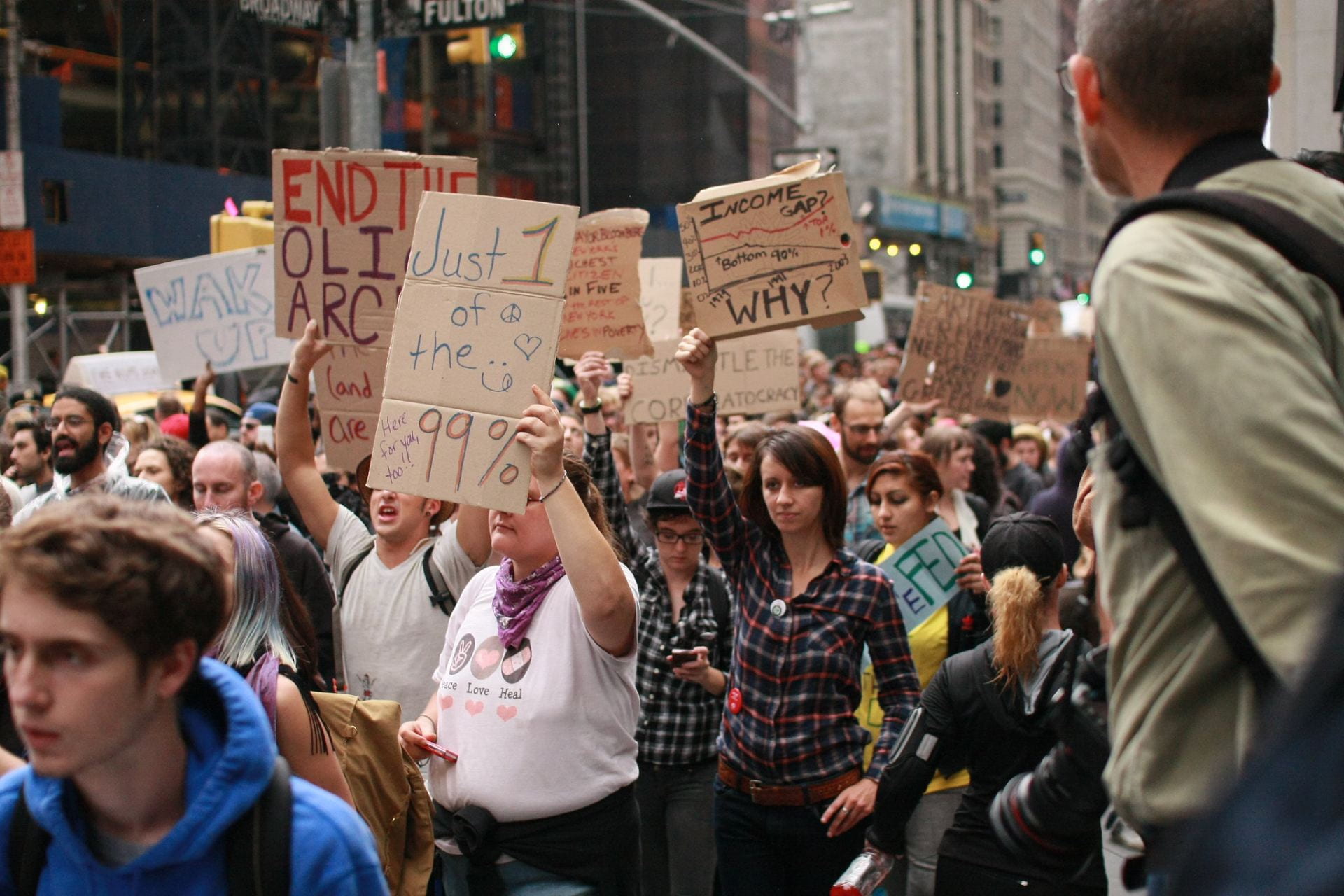
But writing is about exploring the rich fullness of the human experience. Let’s do a little experiment. Look at this photo:

Now at first glance, you probably think it’s some sort of woke mob. You don’t really think of these people as individuals, nor do you consider their individual motivations. “They’re just trying to steal from hardworking billionaires,” you might say to yourself. Some of the more sociopathic of Stories’ Matter viewers might fantasize about following one to their home, strangling them and watching the light go from their eyes. But most of you would probably be fine tear gassing them so they disperse and you can drive to yoga class unimpeded.

But as a writer, use this as an exercise to practice humanizing others. Pick five random people and write a few paragraphs of background.

This woman, for example. Let’s pretend she’s not very politically active but is here to impress this man. You see, last week she first saw him at Whole Foods when he asked if she knew where the arugula was. He was so hot she got tongue-tied and just silently pointed in a random direction, and in fact, she didn’t and still doesn’t know what arugula even is and hopes he doesn’t ever bring it up again. Anyway, she followed him out of the Whole Foods and was excited to learn he only lives a few buildings away so she’s been spending the past few nights hanging around the entrance to his building hoping they’ll cross paths again. If he asks what she’s doing, she’ll say comes to that building to leave food for a stray cat. Anyway, that didn’t happen, he must work nights or something, but this Saturday morning she saw him walk with a group of people to a local protest. And so now she hopes he shouts out some funny slogan or comment so she can laugh really loud and draw his attention.

Anyway, we’ll take radical detours that seem to be pointless on this edition of Stories’ Matter.

~

Now, before we get to the tips, let’s make a clear distinction. Minor characters are not secondary characters. Secondary characters get lots of page space and are crucial to the plot; minor characters are a step below that. To give a relatable analogy, if a main character is a wife, a secondary character is a mistress, and a minor character is a Waffle House waitress from Memphis you once banged while on a book tour whose name and hair color you can’t remember, but you do distinctively remember she got sexually excited by tornadoes.

Tip 1 – Minor Characters Should Feel Like They Have A Life Outside Your Story

A minor character shouldn’t exist just to info dump, nor should their only purpose be to support your protagonist. I mean, in real life the only reason we do things for others is to achieve our own goals. At least that’s how it is for me.

There are lots of ways to do this in your fiction. Give your minor characters a memorable hobby. Hint at a secret motivation. In Blake Colby’s Blood Shot, one of the detectives is trying to solve the crime, but the other is mostly worried about whether or not his wife is having an affair.

This is something I had to learn as a boss, as well. For years, I thought of my workers as mindless drones who only existed to take me more money. But now I make it a point to get to know my employees. For example, every Monday morning, I spend two hours monitoring their social media feeds. This has the added benefit of checking to see if they’re uploading pictures of themselves holding various books from the D&E backlog like I asked.

Tip 2 – Don’t Forget to Give Your Minor Characters a “Look”

Remember, a minor character may only exist on a few pages of a 300-page novel. So you really have to make those words count. Some strange clothing choices or gaping holes where your eyes should be is a great way to grab your reader’s attention.

Try to think of some minor characters in movies whose names you don’t remember but whose look you absolutely do. If you’re anything like me, the first thing that came to mind was the chick with three tits from Total Recall.

There’s science to support this as well. Humans are bad with names, but we’ve been trained to recognize abnormal or differing appearances. This was how we learned to cast sick or genetically inferior people out of our caveman societies. At my publishing company, I remember most people by specific traits instead of names, like “big head,” “nerd face,” “wife material if she smiled more,” and “what I imagine my mom might look like today if she hadn’t abandoned me.”

Tip 3 – Give your minor character a specific role

It’s no secret that lots of books have been written. Because of this, many roles for minor characters have been established. Let’s look at a few.

First, we have comic relief. Think about the gravediggers in Hamlet. In my novel, The House on Pain Avenue, Daniel’s brother’s frat brothers serve as the comic relief. Peeing in the dean’s coffee helps lighten all scenes where Daniel’s father kicks him out of the house for being gay.

Then you have the guide. They are meant to assist the protagonist on their journey. In my novel, Deep Throat II, the titular character guides the journalists in uncovering the president’s pizza parlor child sex ring.

What Hiring A Prostitute To Pretend To Be My Ex-Wife Taught Me About Writing Romance Novels

I have some bad news for fans of the channel: John Lazarus is no longer in a relationship. The prostitute I’ve paying to look, act and talk like my second wife has decided she’s no longer willing to provide me with her services.

It’s a tough thing to say goodbye to someone you still love. All those happy memories we shared — dinners together, movie nights, meetings with plastic surgeons and dialect coaches – just bring me pain and sadness now.

Unfortunately, Destiny decided it was time we moved our separate ways. So much time spent pretending to be someone she wasn’t caused her to lose her own sense of identity, it seems. Once she started dreaming as my second wife, she knew it was time to give nursing school another shot.  

As a romance writer, you will similarly construct a romantic identity for your characters in much the way I did for Destiny. In this article, I will show you how the mistakes I made with her are probably very similar to the mistakes many aspiring writers make when attempting their first romance novel. We’ll try to stop glamourizing underage relationships on this edition of Stories’ Matter.

~

So, if you’re new to the channel, I’ll just give you a little bit of background. I have been married three times in my life, but my second wife was definitely my favorite. But that’s not just because my first wife was a serial bigamist who was already married to several other people, or because my third wife was my therapist who used hypnosis and other forms of psychological manipulation to make me fall in love with her.

Cindy was simply a wonderful woman. And I’m not just talking about a pair that defied gravity or the fact that she introduced me to pegging. Cindy taught me how to cook. She convinced me to start my own publishing firm. She was instrumental in removing my dad from his burial plot, selling the plot to fund a down payment for a new house and then dumping him at sea. She was also the only woman I never cheated on.

But unfortunately, this storybook romance wasn’t meant to last. We parted after two short years together. While my love for her remained strong, she didn’t feel the same way. I’ve had over a decade to wonder what went wrong. Perhaps I was too wrapped up in my writing. Perhaps I was too clingy. Perhaps the fact that her new husband was taller, younger, richer and had more friends than me was my undoing.

In any case, that’s not especially important for the purposes of this article. Because I’m actually here to talk about Destiny, the escort I’ve spent the past six months forcing to look, talk and act like Cindy.

Step One: Forcing Chemistry Instead of Building It

This of course relates to our key writing rule: “Show, don’t tell.” You can’t tell your reader that your characters are in love, you need to show them interacting in an organic way that shows them building chemistry.

If you want to write a story about a reformed Islamic terrorist who falls in love with a female Silicon Valley CFO, that’s fine. “Opposites attract” is a great trope. But you’ve got to find a way to make their connection make sense. Perhaps they slowly bond over their love of Colin Firth movies or something.

Looking back, I realize I forced things with Destiny. The speech therapy is one thing, but making her listen to tapes of Cindy’s voicemails while she slept was too much. Maybe I could’ve called her Destiny on Mondays-Fridays and only forced her to pretend to be Cindy on the weekends.

Step Two: Making One Character Passive in the Relationship

Relationships aren’t about one person seizing control and making all of the choices; this isn’t the state of American democracy in 2025.

And this isn’t just a problem with male writers. You’d be surprised how many manuscripts I get from female writers whose male love interest in their novel is basically a dildo with nice hair who also happens to be a ghost.

I now realize I should’ve given Destiny more agency in our relationship. I should’ve let her choose her own restaurants instead of screaming that “Cindy didn’t like Italian.” I should’ve let her buy that boat even though Cindy was terrified of water because her brother drowned when she was five.

Step Three: Writing Relationships Without Commonalities

Your characters need to be together for a reason. Sure, in real life, people might be put together solely because they’re part of the Chinese government’s attempt to create a superrace of excellent basketball players, but your reader wants your couple to bond over something they share.

They shouldn’t be carbon copies of each other, obviously. They don’t have to love the same music or types of porn. But you still need to make that connection. In my novel Above the Rim, it was shared sexual experiences in basketball arenas. In Heartland, it was the shared belief that 9/11 was an inside job.

When I followed her on her days off, I saw that Destiny was into gardening and visiting her family and volunteering at a dog shelter. Those are all things I wouldn’t dream of doing.

Step Four: Not Allowing For Vulnerability

Human beings are frail things. We aren’t like the common salamander; we can’t survive if our head gets cut off.

It’s important that both members of your couple show weakness and fragility. For example, maybe she had both of her hands chopped off by a helicopter. Maybe he’s a control freak who wiretaps everyone, even his best friends and himself.

It’s clear I expected Destiny not to be the perfect woman but the perfect approximation of Cindy. And I expected myself to be perfect as well. One time, I accidentally called her Destiny while we were having sex. This was particularly egregious because I usually only shout my own name during sex. Anyway, I locked myself in a room for a day after watching home movies of Cindy and I.

Step Five: Having Contrived Conflict for the Sake of Conflict

I mean, sure, in real life couples fight. They slap each other. They throw drinks in each other’s faces. They break each other’s garage doors. They sneak devices that emit chirping sounds once every five minutes under their bed and pretend they can’t hear the sound. That’s all fine and normal.

But in your story, conflict must arise organically. Characters need to remain in character.

After Destiny and I settled into our groove and she really got the character of Cindy down, I tried to reenact a fight Cindy and I had several years earlier. The problem was, because of Destiny’s profession, she was cool with taking a cumshot anywhere. So she wasn’t able to channel Cindy’s rage. The next two days of silence and the following “make up” sex just felt so forced.

Step Six: Portraying Abusive Behavior As Romantic

While this doesn’t really relate to my situation with Destiny, you should try to avoid this. I see this way too often in romance novels.

How Writers Can Deal With Stalkers

Today’s article is the first in our Platinum Club Series, which will cover topics targeting the more successful subscribers of channel, established writers who are starting to see some solid book sales. We’ll cover topics from investing your book revenue in high-yield bonds to what to do with a dead hooker to what to do with an alive hooker.

Authors who’ve sold 1,000 copies of their book will gain immediate membership in our Platinum Club. But for those who know their big break is right around the corner and want to plan ahead, you can also gain membership by purchasing five D&E Publishing titles and submitting the receipts to my sister’s son Bradley, at this email.

totallyrealemailaddress@notafake.com

And we’ll kick off the series with one of the first markers of writing success: being followed by a dangerous, unstable stranger. Having a stalker can be a terrifying and flattering experience, and it can be tough to balance your fear of being gunned down in your doorway with your need to be constantly praised. We’ll keep our eyes open and move to an undisclosed location, on this edition of Stories’ Matter.

Now, the first question you might have is, John, haven’t the internet, Covid, the obesity epidemic and rising gas prices moved stalking online now? Excellent question but you’re getting ahead of me. We’ll talk about online stalking in a bit, but for the sake of this video, we’ll assume you’re popular enough (or at least have a hot enough mouth) to get another human to overcome all of those obstacles (and the increasingly inclement weather produced by climate change) to follow you to your home.

Today’s video will be broken into four parts:

  • Identifying if you’re being stalked
  • Distancing yourself
  • Collecting evidence
  • Asking for help

What is stalking?

According to the judge at my second wife and my custody hearing, stalking is repeated and unwanted contact. But that can be vague. After all, if that were true, I’d never legally be able to hire anyone.

And when I first made it big, I often confused my postal carrier and the local census worker as a stalker. But unlike those guys, a stalker needs to be someone who follows you even after you’ve put up some resistance.

Types of stalkers

Most stalkers want the same thing the rest of us do: love. If you’re a man like me, with an incredible sex drive, it can be difficult to know you’re being stalked by a pretty woman.

Let me share a story: I knew this woman once, a large breasted college student named Daphne who also happened to be double-jointed. Daphne was a big fan and introduced herself to me after I gave a reading on campus. We ended up having sex that night, and though I didn’t realize it at the time, that’s when the stalking began.

She’d make me take her to restaurants and movies, and she’d complain if we didn’t talk for at least thirty minutes every day. She’d come over to my house after work and even suggested moving in with me and paying her share of the rent. I kept having sex with her obviously. But if I had realized how much danger I was putting myself in, I might have acted differently. My advice: Don’t let the people you are intimate with try to be a part of your life.

Though less common, there are other types of stalkers. Death obsessives who wanted to involve you in their murder-suicide, cannibals, who just want a taste of greatness, and child stalkers, who will claim you impregnated their mom 15 years ago before you switched towns.

Avoid Unintentional Signs or Messages

So, once you realize you’re being stalked, it’s important you don’t escalate the situation. When I came on Daphne’s face or did other things I can’t mention on this channel, I was symbolically suggesting that I didn’t mind being stalked.

The best thing to do is just stay completely silent, otherwise you might erroneously send mixed messages. A simple phrase like “Go away” might seem straightforward enough, but to a stalker only proficient in Choctaw, they might assume that you meant “Explore my body.”

Hide Your Personal Information

When I was a hungry young writer, I put my phone number and email address on the front cover of all my books. At the time, it seemed like the easiest way to get the attention of literary agents and publishers. I stopped doing that once I started selling my books at actual bookstores, but unfortunately, a few enterprising fans found the few copies of those early books that weren’t incinerated. And while I don’t think I would’ve minded receiving daily locks of Daphne’s hair in the mail, you might not know where that hair is coming from. But speaking of…

Collecting evidence

If a stalking case gets really out of hand, you might need to do a little stalking back at them. Keep any messages they send you. Record any phone calls. Follow them to their home. Turn it into a descriptive writing exercise, if you don’t want to waste precious writing time.

In Daphne’s case, I memorized the locations of all the moles on her body, the location of her parents’ summer house, and I even collected a sizeable amount of her urine. (Which is something I do for all my female companions, stalker or otherwise, just so I can get a third-party pregnancy test.)

Contact the authorities

If you have a dog you don’t particularly like, you could consider calling the police. While they’ll most likely ignore you, especially if you’re a woman, it will at least be nice to get all your frustrations off your chest. And it’s certainly cheaper than therapy.

Notify your friends, family and co-workers

This one comes with a caveat. If you are being cyberstalked, it’s very likely that you actually know the person who is doing it. It could be a family member who’s upset you didn’t include their ideas in your latest novel, or a coworker who doesn’t understand why you used a phony cancer GoFundMe to fund your marketing campaign.

If you are that rare type of writer with a loving family and supportive friends, you could enlist them to help you scare the stalker away. If you don’t have that, and YouTube analytics tells me it’s likely, you could also post about it on social media.

Of course, your followers could help you, but this could also lead to a multitude of copycat stalkers. If you are very lucky, it may even lead to some sort of battle royale situation, where, after days of unspeakable bloodshed, one final stalker reigns supreme, and sickened by the senseless violence, your champion stalker realizes the error of their ways and decides to walk the Earth to in search of meaning.

How to Write Strong Female Characters

Compelling characters come in all shapes and sizes but for a long time writers assumed that shape was generally 176 centimeters, 71 kilos, with a high center of gravity and without the ability to ovulate. In the past few years however, writers have come to realize people are willing to consume literature with conflicts centering around characters who are female. We’ll look at ways to create strong compelling, independent characters that just happen to have large breasts on this edition of Stories’ Matter.

Now, you might be thinking, hey John, why are you doing this video? Haven’t there been many great examples of female characters in hundreds of years of English fiction? Well, yes and no. While you will find some female characters in works by Shakespeare, Milton and Jane Austen, they aren’t what we’d call psychologically complex. Women in these stories were often docile damsels (Elizabeth Bennet), one-dimensional witches (Lady Scottish Play) or nagging shrews (Joan of Arc).

In most of these stories, the female characters weren’t given much to do. The largest conflict they might face is whether or not they should have sex with their cousin. Or they were simply female versions of male characters (Miss Marple) sold to prevent nineteenth and early twentieth century housewives from succumbing to boredom and turning to laudanum.

However, with advances in technology like the birth control pill, the Hitachi vibrator and the iPhone, things have changed. Readers today want complex female protagonists. Some even want women to spend a whole scene with no males present, though personally I find that a bit stifling as a writer. So what does our strong modern female look like?

She should have the following characteristics. First, she should have her own opinions. Not just about what to cook for dinner or which abortion doctor is her favorite, but even for things like battle strategy or which whiskey pairs well with which cigar. Her unique value system should guide her decisions and often times those might take her in the wrong direction, but at least it gets her out of the house.

Second, she should be her own person. That doesn’t mean she should be totally independent necessarily. If you want to give your female protagonist a husband, just make sure she maintains that independence by cheating on him a lot. Or if you go the other way and make her part of a satanic lesbian coven, maybe she manifests her independence by taking a painting class at the learning annex.

Thirdly, she should have a certain level of toughness. And not just the kind of toughness that comes from enduring childbirth or dealing with your clique of friends constantly critiquing your body weight. This kind of toughness could be, for example, a defense attorney building a case for a man she knew to be a pedophile who also was her youth volleyball coach and father. In my espionage thriller, 39 Days to Doomsday, for example, my female protagonist, an intelligence official, has to bear the guilt of blowing up 45 Palestinian villages in her search for the head of Hamas.

Now that we’ve established what a strong female character is, I have four tips to help you create one on your own.

Step One: Give her flaws

Like their male counterparts, flawed females make for compelling protagonists. Try to avoid cliches, like making her bad at pull ups or mentioning she earns 77 percent what her male co-workers do. You could give her a flaw irrespective of gender, one that you’d give any male protagonist. For example, she could get sexual gratification from fighting with or spitting on strangers on public transit. Or you could give her something uniquely female, but with more originality. For example, in my 2003 Western Whither the Roses Blow, my female lead had ovarian cancer.

Step Two: Give her female allies

When I was starting out as a writer and trying to find ways to implement female characters in my writing, it was difficult writing one female surrounded by a cast of males and not have it devolve into a gangbang. The best way around this is to surround her with other females, unless of course your book is about a satanic lesbian coven. Some good pairings include: mother-daughter, sister-sister, grandmother-aunt, first cousin-second cousin once removed, pregnant woman-lamaze instructor. Try to have them talk about things women might discuss in real life that don’t specifically revolve around men, like whaling and how to deal with the threat of Sharia law.

Step Three: Base your female characters on someone you know

The problem a lot of male and even some female writers have is that they try to base their characters on what they’ve seen in movies. But we all know Hollywood actresses and models aren’t exactly emblematic of actual womanhood. In real life, most women are fat, old, decrepit, missing teeth, and just generally unpleasant to look at.

Mothers, sisters, aunts and grandmothers are a great place to start. But if you’re like me and all of those have died, you still have options. You can hire prostitutes, for example, not for sexual services but for interesting anecdotes. Normal rates still apply, but you’ll be amazed at how the depth of human despair becomes a goldmine for you as a writer. If money is an issue, you can consider joining support groups under false pretenses and only listening to the women.

Step Four: If you have to dwell on her body parts, make it integral to the story

In my first 100 novels, I bestowed all 25 women with speaking parts double-d breasts and I hadn’t even realized it until a female friend pointed it out. As a male writer, it was an honest and understandable mistake, but something you should consciously try to avoid.

However, if you’re too far along in the story and you’ve already got some wonderfully vivid prose depicting your heroine’s mammary abundance that you don’t want to delete, find a way to make it pay off in the third act. Perhaps her d cups take a bullet for a friend. Or perhaps they lead to her downfall, for instance, a refusal to get breast reduction surgery makes her not able escape the villain’s lair.