How To Tackle Social Issues In Your Writing (so people will finally think you are smart)

The Grapes of Wrath. The Jungle. The Handmaid’s Tale. Tek War. Modelland. All classics rich with commentary on important social issues of their day. From labor rights to suffrage to making sure people can’t clone fashion models, these books have sought social justice for real world issues while also being entertaining pieces of fiction in their own right.

Of course, not all stories do this. Some stories are just trying to excite us with good old fashioned space battles and courtroom dramas. But if you really want people to respect you and think you’re smart, and still not have to learn a bunch of difficult math or some shit, weaving social commentary into your writing is a great way to do this.

It could even be argued that fiction is a great way to sway public opinion on real world topics, perhaps even more than a newspaper. If you’re a good writer, your reader will sympathize with your characters and their plight, whereas most people just shrug about all the people who die on the news. Upton Sinclair used his fiction to get labor laws changed, and as I mentioned before on the channel, my novel Slight of Hand led to a three percent decrease in hate crimes against pygmy street performers.

You don’t have to be an especially progressive person, necessarily. You simply need to have an issue that’s near and dear to your heart. While my political views are a bit complicated, I think my weapons arsenal would at least prove that I’m no bleeding heart liberal. But I hate seeing immigrants in the United States demonized just for trying to find a better life for them and their family. The ones I hired at D&E Publishing were mostly great workers, always diligent and positive, even though it was frustrating to have to hire an interpreter to translate their break room conversations recorded by my hidden wiretap I put there when I thought somebody was poisoning me. Anyway, my novel Storming the Gates of Heaven really shined a light on the economic and cultural hardships immigrants face.

We’ll try to build a better world, or at least do some virtue signalling, on this edition of Stories’ Matter.

~

Now you might be asking, John, do I really want to go down this path? What if I piss off the wrong people? Do I really want to have to go take dead animals out of my mailbox every morning and then have to bury them in my yard because the game warden at the local park says you can dump them there any more even though you don’t see why, I mean, you’re just returning them to nature?

Unfortunately, just like traffic, taxes and alimony, social issues are something you can’t avoid.

Look, people are going to hate you no matter what you do. I mean, I once tried to show solidarity with battered women by attending one of their meetings so I could hear their stories and be more sensitive in my writing. But they said that first, men usually aren’t allowed at those meetings, and second, personal firearms absolutely aren’t allowed at those meetings. I tried making up for it by writing A Dressing In Disguise, about a woman who murders an intruder and then gets a taste for bloodlust, going on a rampage to kill forty male sex traffickers along the Eastern seaboard. But the support group didn’t like that because I guess any kind of violence is a trigger for them. And a lot of my old fans didn’t like the idea of a woman who used a knife to do anything besides carve a turkey. So when you get down to it, there’s just no pleasing some people. Just be true to yourself.

Let’s see how we can make sure we approach these issues delicately and powerfully through our fiction.

Tip One: Make your issue part of the story, not the whole story

Your first goal as a writer, besides making a lot of money, should always be to write a compelling story with memorable characters and engrossing drama. Any asshole can just say how they want society to look. That’s what Twitter and podcasts and the White House Press Room are for.

But unlike the White House Press Secretary, a fiction writer has to be able to hide the fact that they’re full of shit. Let’s say you want to write a story about gun violence and how we need more gun control. I mean, I’d think you’re crazy, but that’s beside the point. Give me a story about a man who lives through Vietnam. His arc should be about dealing with his PTSD of the horrors he saw. Maybe he does this by befriending a nun or coaching a little league team or something. And then kill him at the end in a random act of street violence, saving the nun or little league team in the process. You have social commentary about gun violence while the narrative stays true to the character’s arc.  

Tip Two: Decide if you want to use a metaphor or be direct

To be honest, this is a good advice for anything in life. When I ran office meetings and had to talk about important issues to my employees, sometimes I’d yell at them to clean the break room, because the break room was dirty. But sometimes I’d yell at them to clean the break room because it was a metaphor for the sloppiness with our editing and press releases.

If you want to directly tackle the issue in your novel, that could work great. But then you have to make sure your research is impeccable, which will require access to a college library, a place that some people might be banned from for various reasons.

If you want to go the metaphorical route, just make sure your audience is able to connect the issue in your story with the issue in real life. Fahrenheit 451 is obviously about censorship and The Expanse is about prejudice and how billionaires always fuck things up for everybody else.

But audiences were confused by my sci-fi novel Defrosted. I thought it was clearly about science going too far – in the book, a group of scientists clone a murderous Santa Claus – but many of my right-wing readers took it as an allegory for the war on Christmas.

The Truth About Writing Book Series (and about hiring man servants)!

You might not think it at first, but as a writer, there’s a lot you have in common with a drug dealer. You both have to hustle to make money, the cash you do bring in comes from selling a fantasy to clients, and the best of you know how to keep that client hooked and neglecting more important things in their lives.

Hold on, John, you might be saying, I got a college degree that I paid for with my own parents’ money. Don’t lump me in with those criminal street urchins. Well, first of all, drugs are what make our federal government and financial institutions run on, so get off your high horse. But for the purposes of this video, there’s a lot us writers can learn from drug dealers.

You see, each book we write can be thought of as a dose or a high or a trip. If we do it right, we’ll have them clamoring for more. But we’ve got to be reliable. We have to make sure our product is always available on the corner of Douglas and 3rd,, in a manner of speaking. For writers who don’t write series, or even worse hop genres, well, that’d be like your neighborhood crack dealer switching to peyote with no warning.  

An ongoing series is a great way to build a following, even if you’re a small-time author. If there’s one change I’ve noticed in the industry in my 26 years inside it, besides the fact that pretty much everything is sexual harassment nowadays, it’s that the biggest authors are the ones who write series. Take Sarah J. Maas, for example. Now, I’ve never actually read Sarah J. Maas, but any writer who can get their books sold next to the Doritos aisle at Target is doing something right.

But writing a successful series is a tough thing to do. You have to go beyond writing individually compelling works of fiction. We’ll make hugely elaborate plans and hopefully not get bored before we finish them on this edition of Stories’ Matter.

~

Before you start writing a series, there are a series of questions you need to ask yourself. Let’s take a look at them.

Question 1: Do I want to devote years to this project? Do I have any friends or family that might get upset that I won’t answer their teacher’s emails or pick them up from the bus station at midnight?

A book series is definitely something best tackled by a writer whose family is either all dead or who, by this point, doesn’t expect them to ever change.

Question 2: Does the concept behind the series have enough stamina to last for several books?

For example, I was planning on writing a five-book historical fiction series about the assassination of President Garfield, but by book three, I realized my reader was probably getting sick of hearing about 19th century civil service reform.

Question 3: Can you keep track of all the details and weave them throughout your series?

You might want a minor character to appear in the first book and not return until the fifth book, when they’re all grown up and handsome and ready to raw dog the heroine.

But it can be an organizational nightmare.

That’s why when I started the ten-book series, The Blackstone Chronicles, in 2018, I hired a man servant to live with me and keep track of all my ideas. I even got a cot for him to sleep in the corner of my bedroom so he could write down ideas that came to me in my dreams. If he hadn’t stolen my social security number to pay for his wife’s knee surgery, I likely would’ve finished the series.

So let’s say you’ve got no family obligations, a killer concept and a loyal man servant who came cheap on Craigslist. Let’s look at some tips to make sure this series stays strong.

Tip 1: You Need One Overarching Plot and Each Book Needs Its Own Resolution

Cliffhangers are great and everything, but no reader’s going to wait until Book 10 for you to blow your load. In Star Wars, for example, most of the movies end up with them blowing up a death star, but it doesn’t really matter because the overarching plot is to stop this old white guy who, in fairness to him, can do a 1080 barrel roll from a seated position.

I find it helpful to think of the overarching goal first, and then break it into smaller subgoals. When I wrote the They/Them Murders series, the main goal was to uncover the leftist billionaires’ plot to arm trans people to commit murders and other acts of terrorism. But each book was mostly focused on solving an individual murder case. Of course, it turned out the information I was using for research was fabricated by a right-wing conspiracy theory podcast and my first book had endangered the trans community of Missouri so I cancelled the series.

Tip 2: Consider the Format

Like an open box of crackers or a relationship that lasts more than a month, a book series runs the risk of becoming stale. For example, I didn’t need nine books of The Expanse telling to keep reminding me that billionaires are awful. If I needed that reminder, I’d just poke my head outside the window.

So spice things up by switching to a totally different format. Get wild with it. When I wrote the young adult five-book fantasy series, From Mud to Clay, I paused from the quest to find the stones and defeat the evil witch and made Book Four a medieval cookbook. Granted, this was also because I was hoping that writing educational material for children would give me some much-needed tax breaks, but it still shook things up nicely, I think. If I’d actually gotten those tax breaks, I likely would’ve bothered writing Book Five.

Tip 3: Be Consistent

You can’t forget that people are mostly reading these books because they like you and your writing style. Sometimes when looking at yourself in a mirror, it’s a tough thing to remember that people like you.

You can switch formats and genres and add some gratuitous sex scenes, but you shouldn’t try to be something you’re not. If you’re funny, don’t lose your sense of humor. If you’re good at exploring the dark side of humanity, kill a few dogs if your main characters need to survive to the final book.

How To Write a Memoir (even if your life is boring and pointless

Picture this: You’re driving to work one day when a car cuts you off, causing you to spill coffee all over your work clothes. You want to speed ahead and brake check them, but a closer look reveals it’s a mother of four with at least one child in a wheelchair so that’s out of the question. When you get to work, you discover the Filipino man you’ve been paying to do your job for four times less than you drowned in a typhoon. Then lunch gets pushed all the way to twelve, a crow attacks you for throwing rocks at it during your smoke break, and just when you think things can’t get any worse, when you get home, your wife tells you she’s thinking of taking a Yoga class, which means you’ll have to spend a ton of time going through her texts and emails to make sure she’s not cheating on you.

But there’s a silver lining to these misfortunes. They and the life lessons they provide can be perfect inclusions in your memoir. Today, we’ll go over some tips on how to write a memoir on this edition of Stories’ Matter.

~

You might be thinking, Hey John, I’m not a super famous and interesting celebrity, I’m not superior to regular humans, I don’t have a team of underlings to whom I can subject my sex crimes, why would anyone read my memoir? Well, hold on there. Let’s unpack that for a moment.

Memoirs aren’t just for the rich and famous. Sure, people love celebrity gossip, but what makes a memoir truly stand out is the theme and the story, not the personality. Tuesdays with Morrie is one of the most successful memoirs ever, and not only is the subject not a celebrity, he’s a professor at a middling university and the only really important thing he does is die. But the book’s main message – that life is important – clearly resonated with millions of readers.

Anyone can write a memoir so long as they have a good enough story to tell. I’ve long felt that junkies and soldiers were the lowest of the low, the disposable, bottomfeeding leeches of our society least deserving our attention, but the trials and tribulations of drug addiction and war have made for excellent reading.  Something like Angela’s Ashes, also, I think taught many that poor people were worth caring about, at least for however long it took to read the book.

Let’s look at four steps to write the best possible memoirs we can.

Step One: Choose a theme

Like a wedding or a wife swapping key party, memoirs work best if they have a clearly recognizable theme. The theme should be the life lessons you learned and hope to pass along to your reader. Perhaps you’re a veteran teacher who, though decades of hard work and the close bonds you formed with your students, has come to realize free public education was a mistake. Perhaps you just got out of a cult that turned out to be a lot less lucrative than you’d hoped.

Stories of survival are very popular. In my first memoir, Into the Swamp of Madness, I wrote about my harrowing two years as a beat reporter in suburban Jacksonville.

Step Two: Write truthfully

It’s only natural to see the best version of ourselves. We often leave out details or tell obvious lies to seem better in the eyes of others. That’s why my author profile used to say I went to Oxford when I actually never went anywhere, or why I list myself as six foot seven on my Ashley Madison profile, when I’m actually five-nine.

Still, if you want to touch people, you have to reach into those ugly places of yourself and lay it out bare for all to see. Sure, some people might think it odd you’ve had four children from three different marriages run away from home, but most will relate your pain and sorrow. Similarly, I was shocked to learn that Richard Dean Anderson nearly killed his best friend by giving him a homemade blood transfusion, but then I realized these are just people like you or me, and they make the same mistakes we do.

Step Three: Think Like a Fiction Writer

Just because this is a true story doesn’t mean it shouldn’t follow the rules of your own fiction. You need exposition, you need a central conflict, you need to develop character, you need to flesh out your setting and you need an arc. If you’re in the middle of writing and you feel your story lacks the necessary drama, live it out. If you’re a successful executive, expose yourself on a Zoom call to expedite your “fall from grace” narrative. Junkies and alcoholics might need to relapse or go cold turkey, depending on your point in the narrative.

Step Four: Be relatable

Nobody wants to read a story that’s preachy or condescending that isn’t also kink shaming kink erotica. While I’m sure Matthew McConnahey thinks he’s smarter, funnier and exists on a higher plane than the rest of us, he still writes as if he wouldn’t hunt us for sport.

For many of you, this won’t be a problem, as your blandness and middle-class mediocrity will instantly make you relatable. But not all writers have this luxury. So if you’re wealthy, I suggest grabbing a few hollow points and driving through the less well-off parts of town to observe the common man in his natural state. And if you’re poor, sneak into the homes of the middle-class families you’re doing landscaping for see what you can learn.

What Writers Get Wrong About Theme (especially you, Steve)

As an aspiring author, you want your stories to matter, but you’ve got this strange feeling they totally suck. You want your books to have deep, resonant meaning, but you also suspect your readers feel that, aside from a few big words, a child could’ve easily written this. You feel like you have so much knowledge and wisdom to share with world, but at the same time, you feel like if some hitchhiker strangled you and left you dead in a ditch, nobody would really give a shit.

And most of that boils down to theme. Stories aren’t just about heroes winning or titillating violence against cheerleaders. Stories with good themes are a means for us to better understand human nature. Before I read Moby Dick, for example, I never really considered that secretly poisoning my neighbor’s dog that barked at me a lot might’ve been wrong.  

But what is theme? My favorite definition of theme comes from my high school literature teacher whose name I can’t recall.

“Theme is… well, okay, theme’s a thing… it’s an artistic representation… well, you don’t write it in your book, like it’s not something you explicitly… to put it another way, it’s something your reader can understand just by reading your book. It’s the subject of your discourse… or no, it’s, like, the idea they take away from your book.”

“Oh, like the moral of the story. Like ‘don’t kill people for fun.’”

“No, no, it’s not a moral. Theme is not a moral. It actually doesn’t answer any questions. When you create a theme, you’re not being preachy. If anything, a theme raises more questions than it answers. It’s basically what your book is really about.”

“Oh, like a topic.”

“No, it’s not a topic. Okay, think of it like this, if you were in an elevator with someone, what would you say?”

“Umm… Floor 1, please?”

“No, I mean about your book. If you had to explain your book to a person in an elevator in one sentence, how would you do it?”

“Do I know this person?”

“It doesn’t matter.”

“Well, I guess I’d say this story is like an elevator in that it goes…”

“No, that’s not.. Look, nevermind. Just use the word ‘exploration’ in your theme and you should be fine.”

“Exploration of elevators. Got it.”

~

Now, before we get into the specific tips, I’ll start with a question a lot of people ask me:

When planning my novel, should I start with theme, or should I start with plot and character and develop the theme as I go? Also, do you have that 200 dollars you owe me?

It’s a great question that unfortunately doesn’t have a concrete answer. For example, when I wrote It’s All Relative, I knew I wanted to explore the theme of “incest and society’s reaction to it.” Then I slowly developed the characters who were pro and anti-incest and the science fiction plot about incest babies on a generation ship naturally developed from that.

But when I wrote Son of Sam I Am, I just knew I wanted to tell a story about a man with mental disabilities who helps catch a serial killer because there were a lot of very popular TV shows that were basically just that. The theme of the novel–the prejudices that people with mental disabilities face–didn’t present itself until about 2/3s of the way through the novel, when I noticed all my cop characters were being total assholes.

Now, how we can we work to create better themes as throughlines in our writing?

Tip One – Don’t Be Preachy

Nobody likes preachy people. That’s why Democrats always lose elections, and it’s why right-wing ministers have to scare people with an eternity of hellfire to get them to attend church.

So as a writer, you need to be careful that your theme isn’t too on the nose or moralistic. It would’ve been easy to just preach about incest being bad when I wrote It’s All Relative, but instead I wanted to really get into intense debates and explore what incest means to different people. This has a nice side benefit as well. If you’re afraid people will attack you for your political views, being a fiction writer means you don’t need to have any real deep convictions at all and will help you avoid tough questions during interviews.

Tip Two – Embed your theme in your character’s arc

We’ve talked about character arcs on this channel before. Now let’s say you already have a theme in mind. Let’s say that you want your theme to be “Love Conquers all” because you’re trying to get your second wife to realize she shouldn’t have left you and even though her new husband might be younger, taller and he’s got a boat that he actually knows how to operate, that doesn’t mean he loves her more than you.

Okay, now you can construct your main protagonist’s arc around that theme. Your book doesn’t even have to be romantic. Christopher Nolan used the theme to save a dying planet. Maybe, in your story, it’s a love for math that gets your protagonist to turn their life around, stop smoking PCP and win the Fields medal in the end.

Tip Three – Use Symbols and Motifs

Sometimes the best way to deepen the thematic richness of your story is to think small. Think about your word choice. Think about symbols. Think about repeated phrases. In Slaughterhouse Five, Kurt Vonnegut keeps using the phrase “So it goes” to hint at the theme of the uncontrollable nature of fate. In fact, it’s a phrase I love so much, I put it on my first wife’s headstone when she was killed by that biker gang and nobody else was willing to claim her corpse.

In my coming-of-age novel Tomorrow’s Sorrows Borrowed the theme is the disillusionment that comes with entering adulthood. To hint at that theme of disillusionment, the motif of masturbation is used over and over and over and over and over again to show how isolated my main protagonist Catcher Ryerson is.

If You’re a New Author, You’re Probably Making These Mistakes

If you clicked on this article, I’m guessing you’re having some trouble breaking into the industry. You probably have had dozens of rejection letters from literary agents or indie publishers. So you probably self-published some short stories on a blog, maybe even a novel or two on Amazon, but nobody bought it because why would they? You’re a no-name piece of shit. You know you have talent, but if you died today your obituary would likely list you as a masturbator before a writer. What’s an aspiring writer to do? In today’s article, I’ll discuss some of the biggest mistakes new authors make so hopefully, by the end of this, you’ll have a 1 or 2 percent better chance at becoming famous. 

~

#1 – Not attacking critics at every opportunity

Most new writers experience high rates of rejection. And because most of you were terrible at sports and unpopular in high school, you’ve grown accustomed to let the criticism roll right off your back. Fight that urge. You ever notice how the greatest businesspeople, celebrities and politicians are all huge assholes? That’s because people respect and admire assholes.

The more you stand up for yourself, the more people will take you seriously. Get a bad review? Hack your reviewer’s social media and have them proclaim vocal support for NAMBLA. Get rejected by a literary agent or publisher? Hack their social media and post visual depictions of the Prophet Mohammed.

#2 – Limiting your marketing avenues

As I’ve shown, a social media presence is key for any aspiring author, but most writers stop there. In doing so, you lose a lot of potential readers: the elderly, poor people without access to computers, Luddites, obese people whose fingers are too fat to type, or even people who like to go outside.

You can try these things. If it’s a comedy, read your book in a crowded café and laugh loudly. When people ask you about it, say it’s an unknown author who should be way more famous. If money isn’t an issue, promote it with a billboard. And if money really isn’t an issue, promote with skywriting.

#3 – Writing for yourself

Most writers think writing’s supposed to be fun. But really, the only fun thing about the writing process is giving a busty fan your hotel key card at a book signing, but it takes decades for most writers to get to that point.

Writing is a job, plain and simple. No different than being an office worker or a barista or Secretary General of the United Nations. But unlike any of those jobs, you have to take it seriously, because you’re the boss. So if you quit your day job to become a writer, just remind yourself that you’re doing it for the money and not because you thought it’d be more fulfilling than helping autistic children.

#4 – Spending big bucks on a book cover

Ever heard of the phrase “Don’t judge a book by its cover”? Even schoolchildren know that. It’s the content that matters. But I still see new writers drop four figures for an eye-catching cover. Please stop. Do yourself a favor and spend that hard earned cash on something more useful, like editing, alimony or insulin.

#5 – Disregarding the competition

A big mistake a lot of new writers make is thinking that their work will stand on its own merits. But in reality, your reader is just going to compare your work to other authors they’ve read before. So you need to be proactive. Discredit and shame as many famous authors in your genre as you can. For example, Robert Ludlum rose to prominence largely because he was the first to say Tom Clancy had been using orphan ghostwriters.

#6 – Living your life

Lots of writers think they need to live their life to get inspiration for their writing. Oh, really? You writing a hard-hitting thriller about a porn-obsessed chronic masturbator? Are Midwest summer barbeques a bastion of character, wit and intrigue? Your life is boring and pointless, but your fiction shouldn’t be. Family reunions, recitals, baptisms, funerals and pleasuring your wife just gets in the way of those key edits, those opening hooks that need polishing. Focus on the work. It’s all that matters.

Here are a few more mistakes you can fix on your way to becoming famous.

#7 – Not joining the secret Satanic societies to which most literary agents and New York big six publishers belong

#8 – Not getting an email account

#9 – Using the “hunt and peck” method of typing

#10 – Forgetting that agents are open or susceptible to bribes, extortion and blackmail

How to Write Minor Characters

From the barista who makes your coffee, to the nanny who raises your children, to the doorman who keeps drug addicts and couriers serving you legal papers out of your building, our lives depend on little people whose existence we basically never acknowledge.

In literature, perhaps even more than in real life, these little people matter. Your reader will not respond to your writing if your world is populated by flat characters who exist only to serve your main protagonist’s narrative, in much the way a judge might respond to you not remembering the names of your company’s custodians and security guards who died when your building burnt down because you were siphoning electricity from next door.

Sure, it’s much easier to go through life not having to think about all the little slave hands who knitted your socks. And dehumanizing others, while sometimes problematic, has had many great benefits throughout human history. For example, we’ve made an impressive stockpile of weapons should aliens ever arrive and threaten our existence.

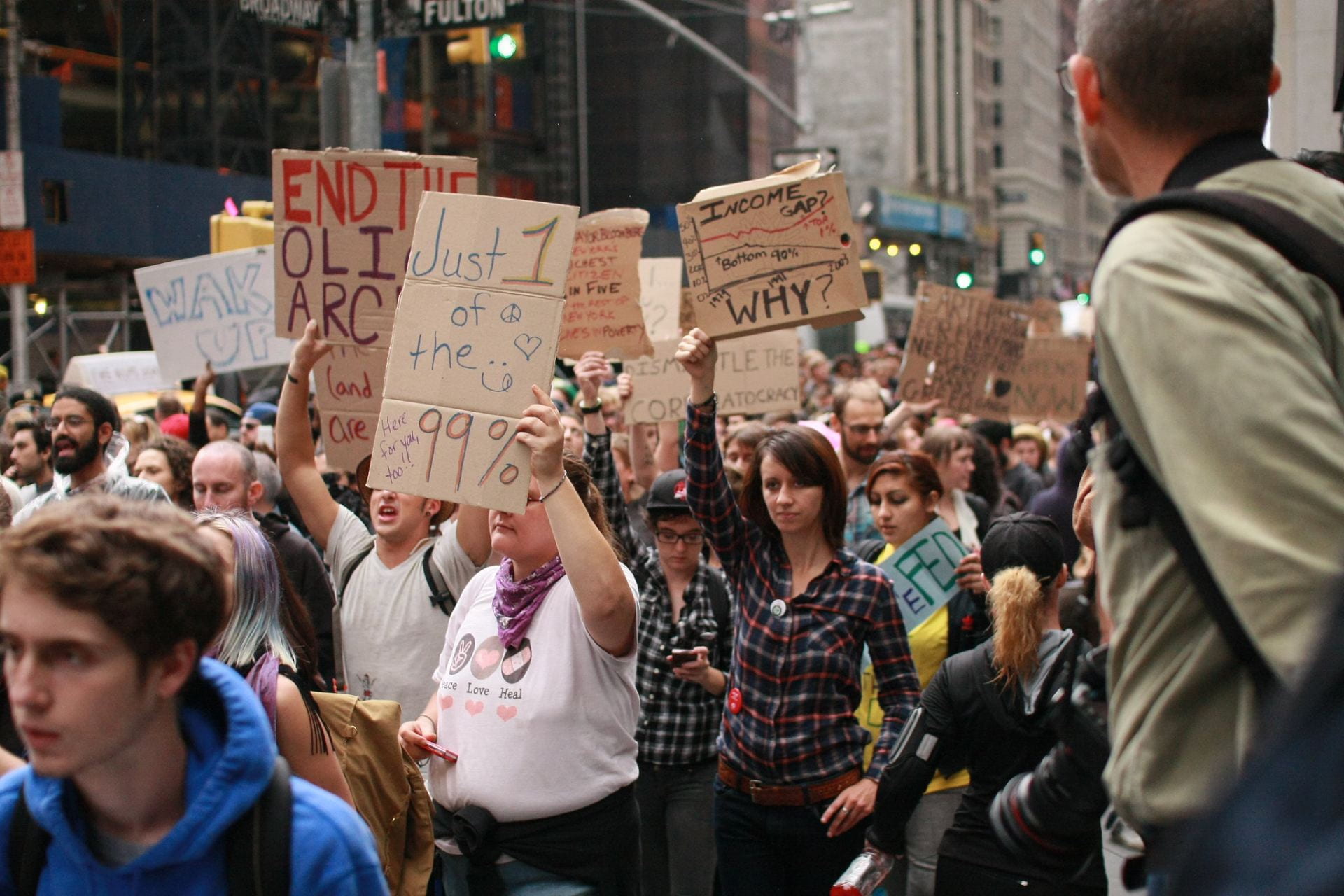
But writing is about exploring the rich fullness of the human experience. Let’s do a little experiment. Look at this photo:

Now at first glance, you probably think it’s some sort of woke mob. You don’t really think of these people as individuals, nor do you consider their individual motivations. “They’re just trying to steal from hardworking billionaires,” you might say to yourself. Some of the more sociopathic of Stories’ Matter viewers might fantasize about following one to their home, strangling them and watching the light go from their eyes. But most of you would probably be fine tear gassing them so they disperse and you can drive to yoga class unimpeded.

But as a writer, use this as an exercise to practice humanizing others. Pick five random people and write a few paragraphs of background.

This woman, for example. Let’s pretend she’s not very politically active but is here to impress this man. You see, last week she first saw him at Whole Foods when he asked if she knew where the arugula was. He was so hot she got tongue-tied and just silently pointed in a random direction, and in fact, she didn’t and still doesn’t know what arugula even is and hopes he doesn’t ever bring it up again. Anyway, she followed him out of the Whole Foods and was excited to learn he only lives a few buildings away so she’s been spending the past few nights hanging around the entrance to his building hoping they’ll cross paths again. If he asks what she’s doing, she’ll say comes to that building to leave food for a stray cat. Anyway, that didn’t happen, he must work nights or something, but this Saturday morning she saw him walk with a group of people to a local protest. And so now she hopes he shouts out some funny slogan or comment so she can laugh really loud and draw his attention.

Anyway, we’ll take radical detours that seem to be pointless on this edition of Stories’ Matter.

~

Now, before we get to the tips, let’s make a clear distinction. Minor characters are not secondary characters. Secondary characters get lots of page space and are crucial to the plot; minor characters are a step below that. To give a relatable analogy, if a main character is a wife, a secondary character is a mistress, and a minor character is a Waffle House waitress from Memphis you once banged while on a book tour whose name and hair color you can’t remember, but you do distinctively remember she got sexually excited by tornadoes.

Tip 1 – Minor Characters Should Feel Like They Have A Life Outside Your Story

A minor character shouldn’t exist just to info dump, nor should their only purpose be to support your protagonist. I mean, in real life the only reason we do things for others is to achieve our own goals. At least that’s how it is for me.

There are lots of ways to do this in your fiction. Give your minor characters a memorable hobby. Hint at a secret motivation. In Blake Colby’s Blood Shot, one of the detectives is trying to solve the crime, but the other is mostly worried about whether or not his wife is having an affair.

This is something I had to learn as a boss, as well. For years, I thought of my workers as mindless drones who only existed to take me more money. But now I make it a point to get to know my employees. For example, every Monday morning, I spend two hours monitoring their social media feeds. This has the added benefit of checking to see if they’re uploading pictures of themselves holding various books from the D&E backlog like I asked.

Tip 2 – Don’t Forget to Give Your Minor Characters a “Look”

Remember, a minor character may only exist on a few pages of a 300-page novel. So you really have to make those words count. Some strange clothing choices or gaping holes where your eyes should be is a great way to grab your reader’s attention.

Try to think of some minor characters in movies whose names you don’t remember but whose look you absolutely do. If you’re anything like me, the first thing that came to mind was the chick with three tits from Total Recall.

There’s science to support this as well. Humans are bad with names, but we’ve been trained to recognize abnormal or differing appearances. This was how we learned to cast sick or genetically inferior people out of our caveman societies. At my publishing company, I remember most people by specific traits instead of names, like “big head,” “nerd face,” “wife material if she smiled more,” and “what I imagine my mom might look like today if she hadn’t abandoned me.”

Tip 3 – Give your minor character a specific role

It’s no secret that lots of books have been written. Because of this, many roles for minor characters have been established. Let’s look at a few.

First, we have comic relief. Think about the gravediggers in Hamlet. In my novel, The House on Pain Avenue, Daniel’s brother’s frat brothers serve as the comic relief. Peeing in the dean’s coffee helps lighten all scenes where Daniel’s father kicks him out of the house for being gay.

Then you have the guide. They are meant to assist the protagonist on their journey. In my novel, Deep Throat II, the titular character guides the journalists in uncovering the president’s pizza parlor child sex ring.

This Query Letter Method Has a Guaranteed 1% Success Rate!

Literary agents: can’t live with ‘em, can’t deal directly with a publisher without getting a restraining order and needing to change your legal name without ‘em.

Writers hate writing query letters for many good reasons: fear of rejection, difficulty distilling a 200,000 word novel into a few sentences, lack of confidence in your salesmanship stemming from the constant death threats you got as an eighteen-year-old telemarketer.

It’s best to think of query letter writing as toadying up to a sick relative in the hopes they’ll include you in their will. So we’ll look at how to put on our best smile and ignore that awful smell and disgusting goiter, so to speak, on this edition of Stories’ Matter.

~

Maybe you need a letter opener. Perfect for creating quick easy access to your mail and for defending yourself against belligerent guests who won’t stop complaining about the smell of your office, you can’t go wrong without a letter opener. Visit your local office supply store for more information.

Before we start, let’s look at what we want a query letter to do. A query letter needs to seduce a prospective agent into believing that you’re going to make them money. Much like a pimp would look at a young man or woman’s body, posture, relationship with law enforcement and tolerance to various illegal substances, an agent will look at your writing credentials, tone, hook and ideas to decide if your book will sell or not.

Here are the main do’s and dont’s for query letter writing.

Do: Sell yourself

Mention any previous publishing credits you have. Mention if you have an MFA. Mention any academic honors related to writing. If you don’t have any of those, and YouTube analytics tells me that’s likely, then simply lie and make them up.

Worried about getting caught. No problem: Just create phony websites for bogus publishers. Write phony press releases and create fake book review sites with very positive reviews of your phony book. Then buy some burner cell phones and list the numbers on your website. Get good at different accents in case they call. Most importantly, whatever you do, don’t be yourself.

Don’t: Reveal too much about yourself

You don’t want to share too much with the agent you’re querying or appear too chummy. Despite everything else I’ll tell you in this video, literary agents are just people like you and me and they’ll see through obvious manipulation.

When I was first starting out, I’d often make the mistake of mentioning I became a writer because a favorite aunt had wished it on her death bed. My hope was to guilt trip the agent into considering my manuscript, but I learned that came off as needy.

Literary agents, I’ve found, also don’t care about what inspired you to write this book, what you or your girlfriend look like naked, what you think the literary agent might look like naked, the models from your vintage typewriter collection, or copies of floor plans of the office where the literary agent works.

Do: Research the agent you’re querying

This is a time-consuming process and you don’t want to waste your time querying an agent who represents, for example, hardcore queer erotica when you’re writing a pastry cookbook. (Though it’s a common mistake, it turns out.)

You also want to make sure your agent actually has connections and works for a reputable agency. If your agent gave you the address of an abandoned office, speaks with a thick Indian accent, their webcam is constantly broken and asks to be paid in Apple gift cards, you might want to ask LinkedIn if Tom Everyman’s profile is legitimate.

Don’t: Forget to proofread

If you can’t get through a one-page letter without a myriad of spelling mistakes and subject-verb confusion, what’s the likelihood you wrote a book that’s going to sell. You don’t want to, for example, say that you wrote this book because your “favorite cunt requested on her death bed.”

Do: Create a strong hook

Just like your book, your query letter needs to start off with a bang. Your hook should answer these three questions. Who is your character? What do they want? What is stopping them from getting it? In my 2009 romantic comedy Just the Tip, I used this hook: Dan Stevens is a down-on-his-luck tax auditor who is forced to audit the woman of his dreams, a young waitress at his favorite Chinese restaurant. And just when he thinks it can’t get any worse, his wife starts asking questions.

Don’t: Try to sympathize with your agent

Don’t say things like “I know you’re very busy” or “I’m sure you must get tired of looking at 1000s of these every day” or “I bet you’d like a nice strong man to rub your shoulders after a stressful day.” Trust me: I’ve tried begging, I’ve tried offering sexual favors or hiring other people to provide them, I’ve tried bribing them, I even wasted a whole month getting one agent’s son released from prison.

But I’ve come to learn one thing. Literary agents are soulless automatons. Now, does the job make them this way or does it merely attract psychopaths who get off on crushing other people’s dreams, is hard to say. Either way, it’s best to think of them as a necessary evil, like a colonoscopy, paying taxes or having to sell your book on a platform owned by a company that forces workers to piss in bottles.  

Here are a few more quick do’s and don’t’s.

Do: Demand writers in your local author group give you copies of their successful query letters and do fake cry if they won’t.

Don’t: Try to stand out by sending a query letter in a strange font like Papyrus or Wingdings.

Do: If you’re querying a male agent, mention things like football and beer, and if you’re querying a female agent, mention things like menstrual cramps and Ruth Bader Ginsberg.

Don’t: Mail a query letter signed in blood to show how serious you are.

How To Write Character Flaws (without just looking in a mirror)

Look around your room right now and try to find something wrong. For example, there might be dirty clothes piled all over the floor. Maybe there are several wedges of half-eaten cheese on different tables in the room. Perhaps there are painful cysts growing in your armpits which your doctor says is likely caused by over-consumption of old cheese. If YouTube analytics is to be believed, all of these things are true.

You might think I’m a psychic. But actually I’m just a writer who, through years of hard work, taught himself to be perceptive of character flaws, in fiction and in real life. And while that didn’t stop me from marrying a woman who turned out to be a serial bigamist, it did teach me to write many complex heroes with compelling characterization. We’ll explore how to exploit our worst personal demons to earn a few bucks on this edition of Stories’ Matter.

~

No one is perfect. For writers with large egos, sometimes this can be hard to remember. Hell, as a man who was first published at 25, sports a full head of hair at 52 and has erections that last three hours and fifty-nine minutes, sometimes it’s hard for me to think of any personal flaws. But trust me, I’ve got plenty. For example, as I’m writing this article, I happen to be twirling a loaded pistol.

In any case, it’s flaws that give your characters depth, that make them relatable and memorable. But it’s important to remember that flaws are always internal, never external. So having an alcoholic mother or living in Ohio aren’t flaws, depressing as they may be. We’ll start by looking at different kinds of flaws and analyze some classic examples from fiction.

~

Minor Flaws

For starters, we have minor flaws. These are often unique or memorable, but don’t have any real impact on your narrative. Indiana Jones’s fear of snakes is a classic example of a fun, humanizing flaw. In my revenge novel set in Georgian England, Bride of Prejudice, Leeandra has a hideous scar that runs from her right temple to her left tit. It’s a unique character trait but doesn’t really affect her or her arc in any way.

Major Flaws

Then, we have major flaws. These are catalysts for action and they drive the story. For Holden Caulfield, it’s his self-pride and inability to cope with his trauma that sets him at odds with everyone in the story. For Kable Anderken in Blake Colby’s Blood Shot, it the memories of missing free throws to get an 8th seed in the playoffs that haunt him.

Fatal Flaws

Then, we have the fatal flaw. These either make or break the character. For the hero, the whole story might be about overcoming this flaw and for the villain, it’s often their downfall. Ahab’s obsession for revenge and Humbert Humbert’s pedophilia are classic examples here. And in the sitcom, Heil Honey, I’m Home, it’s Hitler’s lack of social graces that ruin the dinner party.

Now let’s look at some ways to construct our own character flaws.

Step One: Create Relatable Flaws

If you want your reader to connect with your character, there’s nothing better than making them relatable. Think of common flaws that most people have. Maybe your character masturbates 10 times a day.  Or maybe they’re bad with money, spending half their income on antique guns.

In one of my early stories, Zero Point Infinity, one of the characters constantly tries to kill himself but is thwarted at every turn. Almost every reader I talked to, most of them millennials, felt like this spoke to them on a deep personal level.

Step Two: Don’t Get Preachy

This is especially important when writing villains. Like a bartender or the guy who cleans the elevators in the Aruba Holiday Inn, a fiction writer shouldn’t moralize. Your writing loses its effectiveness if you don’t let your characters beliefs and actions speak for themselves.

In Crime and Punishment, for example, Dostoyevsky isn’t concerned with the moral implications of what Raskolnikov has done. He’s just trying to tell an exciting murder mystery.

Step Three: Create a Balance Between Positive and Negative

Saints and demons aren’t interesting. The worst of us have our virtues and best have our flaws. Hell, Hitler was a vegetarian and Steven Seagal donates to environmental causes. And then there’s Mister Rogers, who somehow thought children wanted to look at this fucking thing.

Complex and three-dimensional characters should be balanced. Like how Sherlock Holmes’s brilliance is balanced by his lust for cocaine. Or like how the dumbass clones in Never Let Me Go’s generosity is balanced by their inability to realize they ought to just go on a rampage and murder everyone.

Step Four: Use Flaws to Create Conflict

Think of any drama you experienced in real life. It was probably caused by a personal flaw. Maybe you got in a car crash because you really liked the way you looked in the rearview mirror. Maybe you lost your job because you’re so fucking dumb you thought the world’s most obvious conman really was looking out for what’s best for you. It could be anything.

In fiction, flaws like these should drive the narrative. Recklessness might get your hero’s friends killed. Callousness might tear a friendship apart. In basically any noir, being a thirsty simp for crazy strange is nearly always a catalyst for destruction. In my drama Storming the Gates of Heaven, the prejudice of the protagonist gets the story in motion. Karl Eichmann shoots a Mexican that he thinks is trying to illegally enter the US, only to find out that Grand Canyon isn’t actually located on the border between Mexico and the United States.

How to Write Diverse Characters (that even racists and misogynists will love)

Whenever I start my writing workshops at the learning annex, one of the first questions students always ask me, after “Is this class fee refundable,” is “Is it okay to write about characters of a different race or sexual orientation?”

It’s a tough world out there right now. In addition to worrying about honing your skills, trying to get your name out there and getting cease and desist letters from your family to stop putting personal information about them in your YouTube videos, you also have to worry about getting cancelled.

You might feel like you wrote the perfect first page, one that was poetic and enticing and instantly draws the reader into your unique world, but after you think more about it, you get anxious that the woke mob will go after you for using the N-word six times.  In today’s video, I’ll show you how even the straightest, whitest Oberlin graduate who grew up in the suburbs of Indianapolis can write about any race, creed, gender or sexual identity. We’re going to put on our metaphorical blackface on this edition of Stories’ Matter.

Race, religion, LGBT issues… lots of writers want to shy away from these topics. But the whole reason you’re a writer is to explore the unexplored and represent the underrepresented. We need more books about unique people and unique perspectives. Plus, it’s unfair to ask writers to limit their writing to their own personal experience. If that were the case, nobody from Omaha could ever succeed because who the hell wants to read a book set in modern-day Nebraska?

Before I get to the advice, I want you to relax. Acknowledge your discomfort, but be open to everything. We’ll never make any progress if we embrace our ignorance. Don’t be afraid to ask stupid questions in the comments. Men, don’t be afraid to ask our female viewership how a vagina works. Black people, don’t be afraid to ask our Chinese, Japanese and Korean viewership what the different slurs for “blacks” are in their native language so you can finally know what those people at the laundromat are really saying.

Step One: Do your research

As with anything else you write, a good story begins with great research. Don’t even think about race, gender or identity for a minute. Pretend you’re a Mormon who wants to write a book about an alcoholic. How would you go about doing it? Now, if it were me, I might do a few different things. I’d watch home movies of my father. I’d attend local AA meetings under false pretenses to get ideas. I’d hang out under a bridge at night. And in fact, these are all things I did when I wrote Plastered Bastard, a revenge thriller about a serial vehicle manslaughter perpetrator.

So when you are writing about another race, you need to come to know that race very well. Do the things you might think a person of that race does. Listen to recorded speeches of beloved political leaders, for example. Watch gay porn. Watch anime. Email your manuscript to someone in your office of that race, even if you don’t know them very well, to get their input. And if they’re a janitor without an email address, print out a copy and put it in their utility shed, as I’ve often done.

Step Two: Describe Your Characters in Detail – When I was teaching at the learning annex, I can’t tell you how many people would give me vivid, detailed descriptions of their white characters while the minority characters were just Black or Asian and the reader was supposed to fill in the blanks. Whenever I came across this, not only did I make this person write an apology to each member of the class, but I also made them wear a sandwich board that said “Ignorant Racist” for the rest of the lesson.

Let’s take an example.

Look at this woman. How would you describe her? Would black suffice? I don’t think so. I would describe her body as voluptuous and her lips as pouty and full. I would say that “her hair was shiny and silken and I wanted her to stand over me, completely naked, bending down and dangling the hair so it was just gently tickling the skin on my chest until I reached orgasm.”

Step Three: Don’t Be Ambiguous

For a writer, specificity is everything. In addition to your descriptions,  this also applies to your diverse characters’ backgrounds. Your character should never just be Native American or Mexican. Are they from the hills of Sinaloa or the slums of Juarez? It doesn’t just apply to race. When I write gay men, the first decision I have to make is if he’s a top or a bottom. Then I ask, Does he generate the power or is he just receiving the power? Does he prefer reach arounds or is he willing to let the release come of its own accord?

Step Four: Avoid Savior Narratives

At the learning annex, I used to have this one student. We’ll just call him Jeff Stanley Wilson. Though he was an older guy, he was about as woke as a boomer gets. He followed all of the above rules pretty well and created some diverse, three dimensional characters of color and other sexual orientations. But Jeff’s problem was his heroes were always white males. And they also were described exactly the way he looked, bald head, glasses and six foot seven. And they were also all named Jeff Stanley Wilson.

I always told Jeff that he was limiting himself as a writer by doing this. Sure, like Jeff you may write as a kind of wish-fulfillment to forget that your wife left you and your son was killed by a drunk driver, but it sends the wrong message to say that people of color rely on whites to be saved. And it’s just not very true to life. I mean, look at… all of history.

I Wrote 51 Books in One Year… Here’s What I Learned

If there’s one mistake I’ve made in this series, it’s that I haven’t told you enough about myself. Any asshole can get on the internet and give you writing advice with zero credentials. Why should you trust me?

After all, I don’t show my face and I use a pseudonym and, if you listen closely, I frequently have the faint sounds of screaming in the background audio of my videos I can’t edit out. But the truth of the matter is, there’s a lot to be learned from my twenty-five years of experience as a writer, from both my successes and my failures.

In today’s video, we’ll take a deep dive into the most productive year of my career and I’ll share the things I learned about productivity, the elements of fiction and crippling drug addiction. And if nothing else, you’ll be able to identify the warning signs that someone is secretly poisoning you. Let’s ink up our pens and put on our writing gloves to prevent pussing blisters on this edition of Stories’ Matter.

~

Let me set the scene. The year is 2008. The global financial crisis had displaced thousands of hard-working investment bankers and hedge fund managers. America was well on its way to electing its first half-Kenyan president. And Hawthorn had shocked the world and won the AFL grand final.

This was about one decade into my career. As fans of the channel will know, the very beginning of my career was bumpy. I made the rookie mistake of working with the first publisher who would have me, a fringe publisher with no offices who wanted to publish my series of novels about serial killers who brutalize women for all the wrong reasons. And then my second publisher, while more reputable, had set it up so I lost money on every book I sold.

Then, in 2003, into my life came Tabitha Cartwright. Because of certain legal agreements, I can’t go into too many specifics about our relationship, but despite how things ended, it was certainly the most fruitful collaboration of career. She was, just to give an example, the first person who told me I shouldn’t endow all my female characters with DD breasts.

I finally was able to write a book that sold more than 1000 copies. And I grew immensely as a writer, with a much better understanding of narrative convention, how to market my books and myself, how to speak to publishers. Soon, I was churning out books like L. Ron Hubbard possessed by the spirit of Xenu himself. In the final year, 2008, I wrote 51. Here’s what I learned:

Lesson 1: It all starts with a strict routine

As a writer, it’s not enough to want it. You can say you’re determined all you want. The junkies at the support group I’ve joined under false pretenses to get ideas for my writing say it all the time before they inevitably relapse.

But having a strict routine enforces determination. You can see my video on my writing routine here. To paraphrase, you should design a routine that provides the following things: time to write, ways to make writing your happy place, time to edit and…

Lesson 2: Punishment for not following your routine

You can’t let life get in the way of a good idea. Think of what our world might be like if Einstein hadn’t been absolutely revolting to his wife so he could focus on his work.

But it’s not enough to miss recitals or funerals and stay home to write. You need a concrete method for making sure you meet your deadlines. Some people might hook up car batteries to their body and their alarm clock, but I’m not a science guy. As I told you in my writer’s block video, the most effective way to stick to a deadline is to hire ex-cons to inflict physical punishment for missing deadlines.

I got the idea from my loan shark and it worked wonders. Make sure you set clear rules and boundaries. Obviously, you don’t want your fingers broken or that would defeat the whole purpose. But if they rough your face just enough to avoid needing to see the doctor, you’ll find yourself motivated.

Lesson 3: Make sure your POV is consistent

Lots of writers worry about plot holes or creating snappy dialogue. But almost nobody realizes the importance of having a consistent POV that serves a specific function.

Maybe it was because I was writing 15,000 words every day and only getting up when I hallucinated that somebody was knocking on my door, but I would slide between third-person omniscient and third-person limited often.

Lesson 4: Big ideas are more important than details or spelling errors or turning in your final manuscript on the back of horse race pick slips

Whether you’re writing for thirty minutes a day after work or you’re writing all night just to avoid you sleep paralysis demon, keep in mind that publishers and consumers care about the big picture. A unique hook will draw more readers than a completely unfinished chapter will push them away. At least with the latter, you can disguise it as a metaphor.

Lesson 5: There are a lot of legal amphetamines

So after Book 30, even I was a little surprised by my own productivity. I mean, I knew story structure in and out and I also didn’t have to cook or clean or bathe myself because Tabitha had hired a maid to do all that for me.

I was always driven and never had the most normal sleep patterns, but it did seem strange to be awake for 72 straight hours and then crash for the following 16. And it turns out the aspirin the maid was giving me was actually an amphetamine responsible for my loss of sleep.

When I confronted Tabitha, she said it was legal, took me to the pharmacy where she bought it and said it was no different than putting her dog’s heart worm medication in his biscuits.

If I wasn’t so horribly addicted by that point, I probably would’ve gotten mad.

Lesson 6: Sleep Deprivation can lead to memory loss

Just like a porn star and calculus teacher, a writer needs to know their limits. Mine were thrust upon me. Books 32 to 47 are all lost to memory. The only evidence I have of those few months is the final product of 15 very poorly written novels and a very terrible Bernie Madoff Halloween costume.

I’m pretty sure I stopped taking the drug at some point during this period only due to the fact that I am not dead. To this day, I’m still not sure if was through sheer willpower or if Tabitha simply realized my books weren’t selling enough to pay for the pills, the maid and the baby I somehow put inside her.

Anyway, if you’re going to write 51 books this year, make sure to take care of your physical and mental well-being.